Tail Lift NZ: Types, Capacities and What to Check Before You Fit One
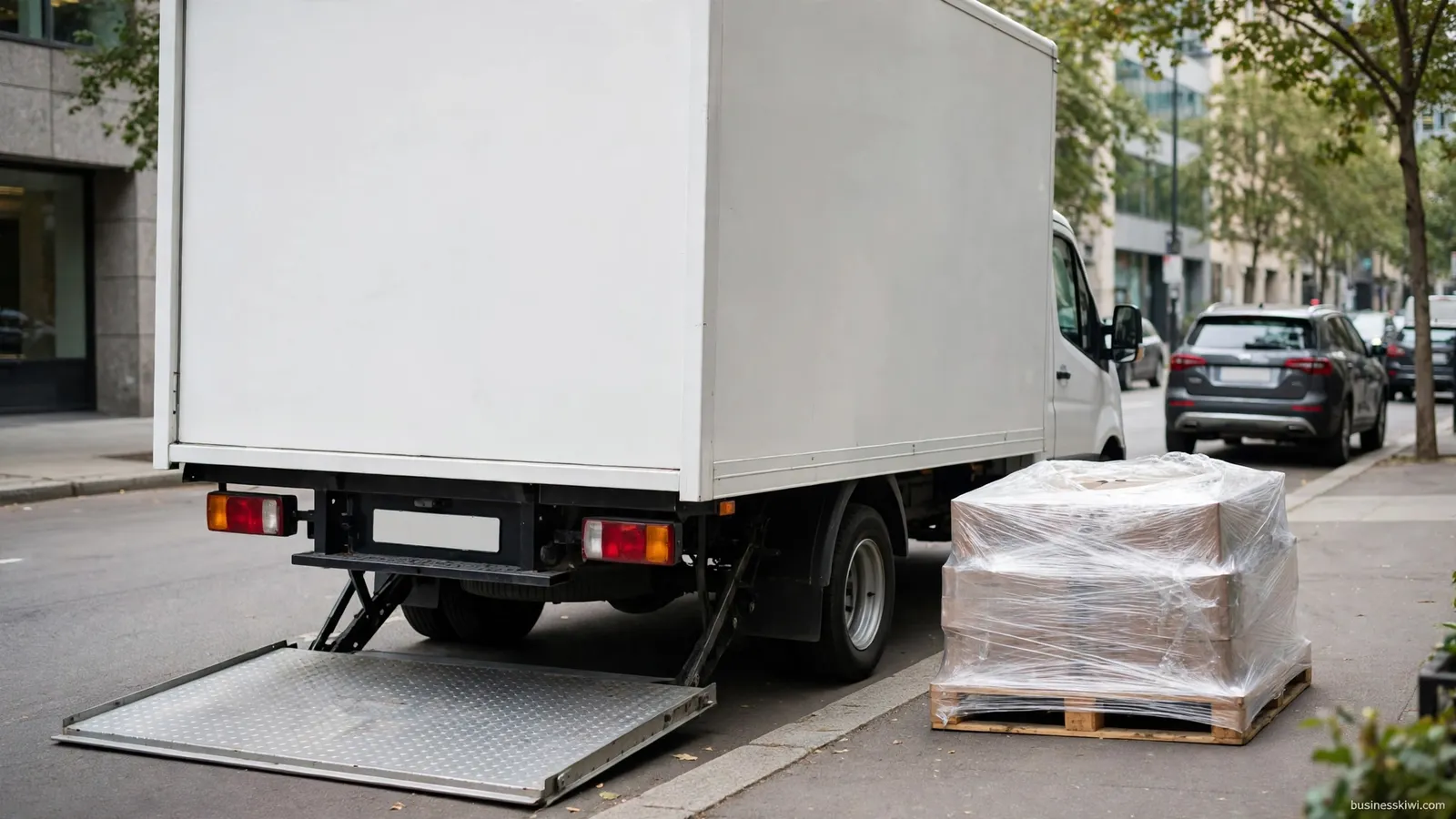
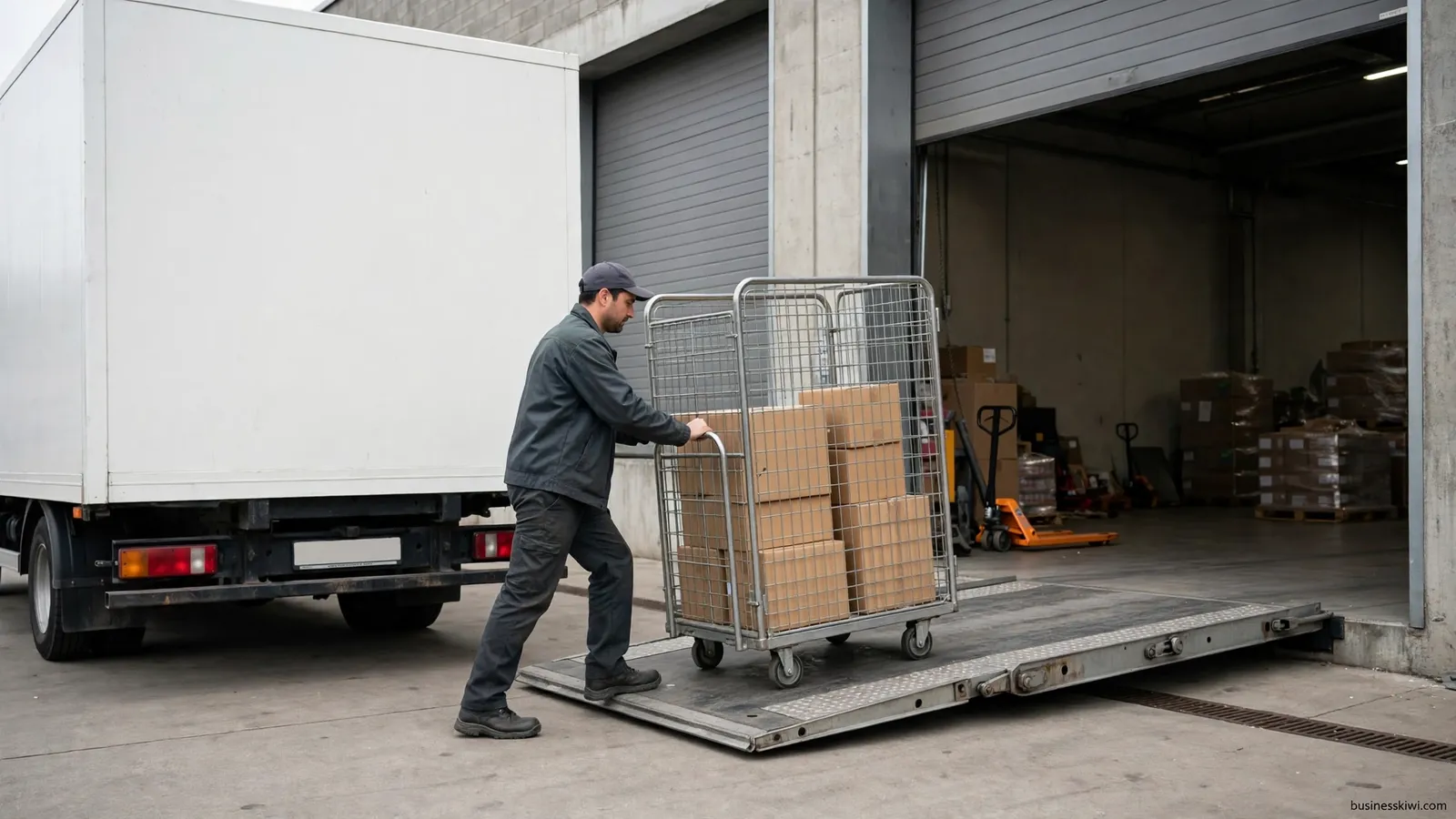
A tail lift is the piece of kit that turns a two-person heave into a one-person roll. Instead of dragging a pallet, a fridge or a loaded cage up a ramp or lifting it by hand, the driver lowers a platform to the ground, rolls the load on, and lets hydraulics do the lifting up to floor level. For delivery fleets, couriers, movers, trades and rural carriers, it is often the difference between a safe delivery and a back injury at the kerb.
This guide covers the main types sold for New Zealand trucks, vans and utes, how to read the capacity ratings honestly, and the NZ rules around fitting and using one. Every capacity figure comes from a maker’s own published material, tied to the model or range it belongs to. Prices are a different story, and this guide is upfront about that.
The short answer
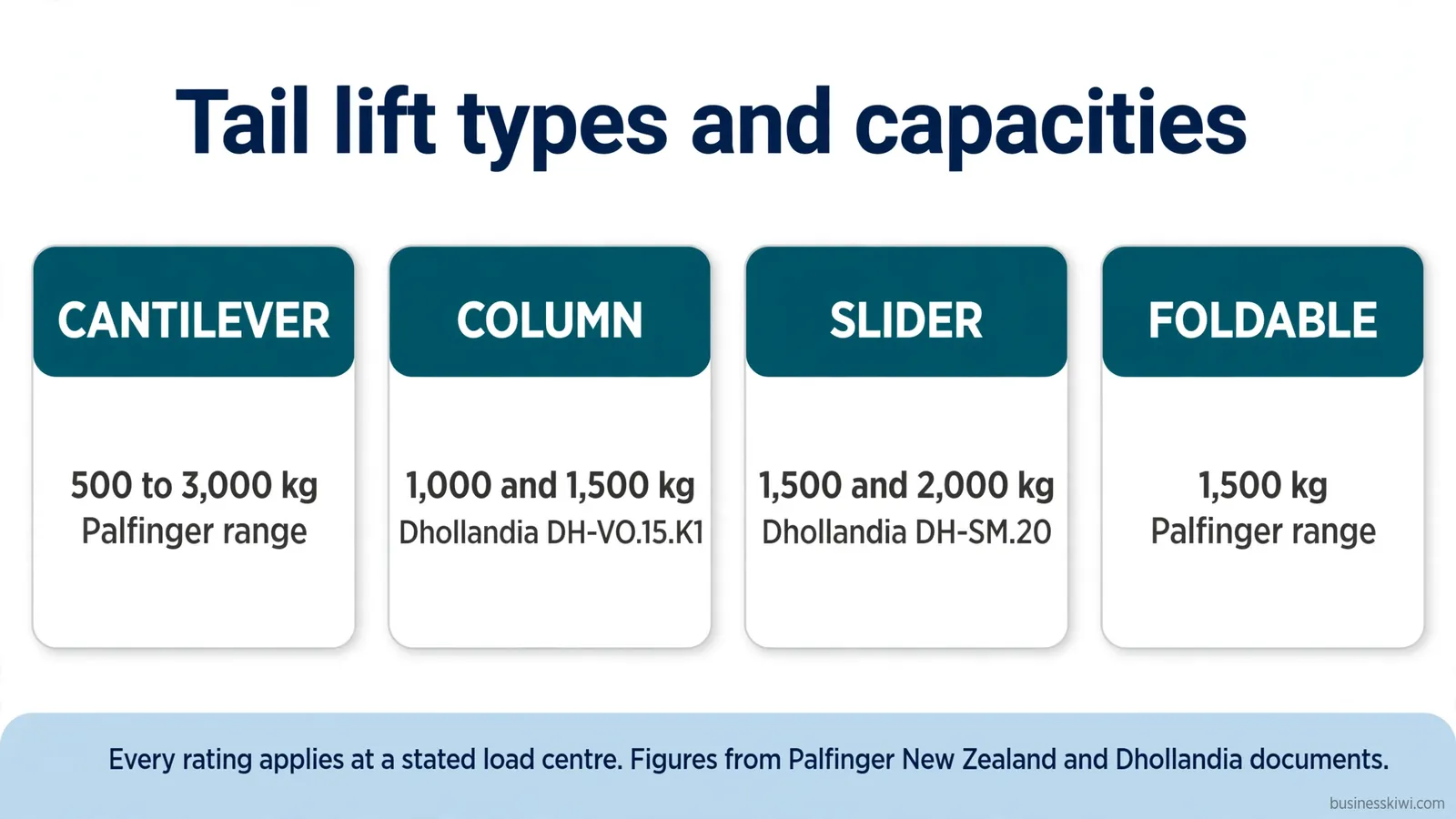
A tail lift is a hydraulically powered platform fitted to the back of a truck, van or ute, carrying goods between the ground and the cargo floor so nobody has to lift them by hand. The four designs you will meet are cantilever lifts, column lifts, slider lifts (also called retractable or tuck-away lifts) and foldable lifts. Palfinger New Zealand puts most models somewhere between 500 kg and 3,000 kg of capacity, and the right figure for you is your heaviest regular load, not your average one. Two things catch buyers out. First, a rating only applies at a stated load centre, so a load at the outer edge counts for more than the same load hard against the body. Second, fitting a lift to a heavy vehicle can be a structural modification, and NZTA Waka Kotahi requires changes to a heavy vehicle’s structure or layout to be overseen by a heavy vehicle specialist certifier. Budget for the lift’s own weight too, because every kilogram of it comes off your legal payload.
What a tail lift is and how it works
The basic machine is simple. A platform, usually aluminium or steel, is mounted at the rear of the vehicle. A hydraulic power pack, driven from the vehicle’s electrical system, works cylinders that raise and lower the platform between ground level and the cargo floor. The driver works it from a fixed control box, a wander lead or, on some setups, a remote.
What changes between models is how the platform is carried. On some lifts it hangs from hinged arms. On others it rides up and down a pair of columns, or slides away under the floor when it is not needed. Those differences decide what the lift is good at: how much it can carry, whether the platform stays flat or tilts, whether the rear stays clear for forklifts and docks, and how much the unit weighs.
The main types of tail lift
Cantilever lifts
The cantilever is the workhorse design. The platform is carried on hinged arms bolted to the chassis, and it folds up vertically to form part of the rear closure of the body. Because the arms can tilt the platform, the outer edge can be set down to match the angle of the ground, which makes rolling a pallet truck or a cage on and off easier on uneven sites. Palfinger New Zealand describes its cantilever range as suiting trucks and vans from 3.5 tonnes to over 12 tonnes, with capacities from 500 kg to 3,000 kg, and points to heavy loads, general freight and multi-drop work as the natural fit.
Column lifts
A column lift carries the platform between two vertical columns fixed at the rear corners of the body. The platform travels straight up and down and stays horizontal the whole way, which is why Palfinger New Zealand points beverage distribution, home deliveries and tall truck bodies towards this design.
Dhollandia’s DH-VO.15.K1 is its heavy-duty column example. The lift is driven by a single cylinder in a beam at floor level, working through chains and pulleys, and it is rated at 1,000 kg or 1,500 kg. Standard platform depths run from 1,000 mm to 1,500 mm. Options include hydraulic closure, roll stops, hinged ramps and safety rails.
Slider lifts (retractable or tuck-away)
A slider lift stores its platform underneath the vehicle floor. When you need it, the platform slides out and unfolds; when you do not, the rear of the truck is completely clear. That clear rear is the whole point. It suits operations that are loaded by forklift part of the time and by hand at the kerb the rest of the time, and trucks that back onto loading docks. Palfinger New Zealand rates its retractable range at 500 kg to 2,000 kg.
Dhollandia’s DH-SM.20 is the maker’s medium-duty slider, rated at 1,500 kg or 2,000 kg. In travel position it sits underneath the chassis, which the maker pitches at work needing frequent forklift loading or dock access.
Foldable lifts
A foldable lift also lives under the vehicle, but the platform unfolds to form the lifting surface rather than sliding out as one piece. Palfinger New Zealand lists foldable lifts at 1,500 kg and points them at construction sites and rural work, where the rear needs to stay clear for other loading methods between lifts.
Capacities: read the rating properly
Capacity is the number everyone shops on, and it is the number most often misread. Three things sit behind the headline figure.
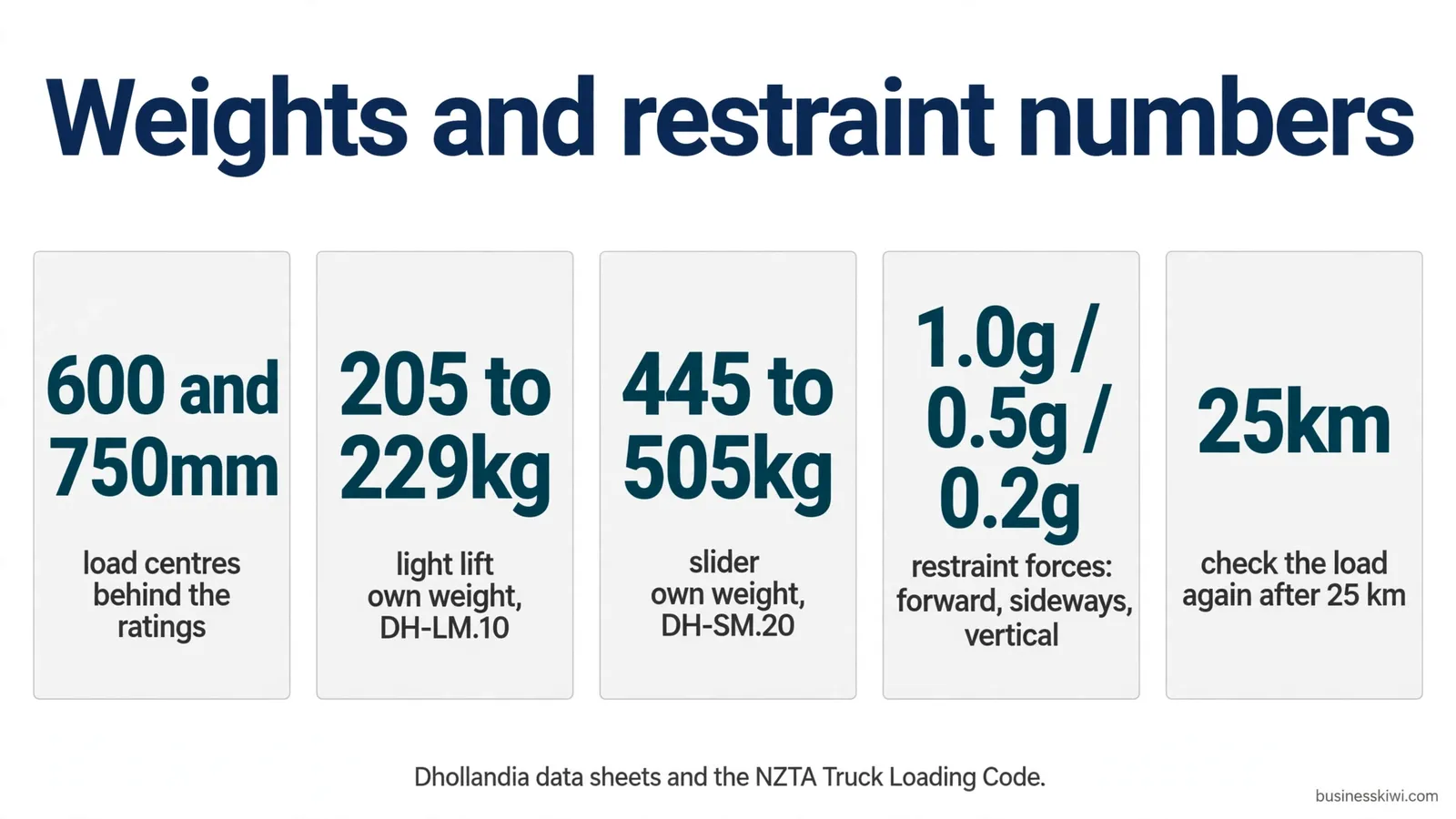
The load centre. A maker’s rating is quoted at a load centre, meaning the distance from the body at which the load’s weight is assumed to act. Dhollandia’s DH-LM.10 datasheet gives its 500 kg rating at a 600 mm load centre and its 750 kg and 1,000 kg ratings at 750 mm, alongside a maximum lifting moment of 3 kNm for the smallest version and 7.5 kNm for the largest. The DH-SM.20 slider shows the same logic: 1,500 kg at a 750 mm load centre gives a lifting moment of 11.25 kNm, and the 2,000 kg version gives 15 kNm. In plain terms, the further out towards the edge of the platform your load sits, the harder the lift is working. A heavy pallet parked at the outer edge is a bigger ask than the same pallet tucked against the body, whatever the badge says.
The lift’s own weight. A tail lift is heavy, and its weight comes straight off the payload the vehicle can legally carry. Dhollandia publishes the DH-LM.10 at 205 kg to 229 kg depending on platform size and material. The bigger DH-SM.20 slider runs from 445 kg to 505 kg. On a small truck working close to its gross weight, half a tonne of lift can be the difference between a legal load and an overloaded one.
Your heaviest load, not your average. Palfinger New Zealand’s buying advice is direct: choose based on your heaviest regular load. A lift that spends its life near its limit works harder, wears faster and leaves no margin on the day something heavier turns up. And remember what rides up with the load. If the driver and a pallet truck travel on the platform with the goods, their weight is part of what the platform is carrying, so count it.
Choosing for a truck, van or ute
For a truck doing palletised multi-drop work, the contest is usually between a cantilever and a slider. Pick the cantilever if the lift does most of the work and the truck rarely meets a dock, because the tilting platform is forgiving on rough ground. Pick the slider if the truck is forklift-loaded at a depot and the lift only earns its keep at delivery points. Tall bodies and loads that must stay level point to a column lift.
For a van, size and weight discipline matter more than raw capacity. Palfinger New Zealand notes that vans often pair well with vertical (column) lifts because they are compact and travel level, and the light cantilever class exists for vans too: Dhollandia’s DH-LM.10 is built for commercial vans and light trucks, with quick-fit bolt-on plates for common chassis. Always check the lift weight against the van’s remaining payload, because vans run out of payload long before they run out of space.
For a ute, be realistic. Palfinger New Zealand includes utes in the vehicles its lifts are built for, but a ute deck is high and narrow compared with a truck body, and the lift still comes off the ute’s payload. Ute fitments sit at the light end of the market, and a good installer will tell you quickly whether your vehicle and loads are a sensible match.
Fitting one: installation and certification in NZ
Modern lifts are mostly bolt-on rather than welded. Dhollandia’s light cantilever, for example, is offered with universal bolt-on mounting plates or brand-specific quick-fit plates, which shortens fitting time and avoids cutting the chassis. Do not mistake bolt-on for consequence-free, though. The lift changes the vehicle’s weight and rear overhang, and it has to suit the chassis type, wheelbase and overhang of the specific vehicle.
For heavy vehicles, NZ has a formal route. NZTA Waka Kotahi states that if you want to change the structure or layout of a heavy vehicle, you need a heavy vehicle specialist certifier to oversee the work. When the certifier is satisfied, they issue an LT400 form, which you present to a heavy vehicle testing station. Chassis modifications and load anchorage standards are among the areas NZTA lists as potentially needing attention, and dimensions and mass must stay within the Land Transport Rule: Vehicle Dimensions and Mass 2016. Involve the certifier and the installer before the lift is ordered, not after it is bolted on. A reputable NZ installer will build the certification step into the job; if yours does not mention it, ask why.
For vans and utes on a warrant of fitness rather than a certificate of fitness, this guide could not verify a tail-lift-specific certification rule from an official source. The honest advice is the same shape: ask the installer, before fitting, what certification or inspection the finished job needs, and get the answer in writing.
Safe use, day to day
Most tail lift incidents are not exotic. They are loads rolling off platforms, platforms overloaded at the edge, and people in the wrong place at the wrong time. The makers’ own material points at the habits that prevent them.
Keep the load centred and as close to the body as the job allows, because that is where the rating is strongest. Use the hardware fitted for the job. Roll stops exist to stop wheeled loads (cages, trolleys, pallet trucks, gas bottles) rolling off the platform, and Dhollandia lists roll stops, hinged ramps and safety rails across its column range for exactly that reason. Deploy them before you lift, not after the load starts moving.
Work tidy. Check the platform and controls before the first lift of the day, keep bystanders out of the arc of the platform, and never leave a loaded platform raised and unattended. If the lift behaves oddly (slow, jerky, or drifting down), stop using it and get it looked at.
Once the goods are on board: load security still applies
A tail lift ends at the truck floor. NZ law does not. NZTA’s safe loading guidance is clear that you must never overload the vehicle, must stay within the manufacturer’s maximum laden weight or the maximum legal weight on individual axles, and must restrain the load so it cannot shift forwards, backwards, sideways or upwards. The official Truck Loading Code sets the performance standard: restraint must hold the full weight of the load under forward braking forces (1.0g), half the weight sideways and rearwards (0.5g), and one-fifth of the weight vertically over bumps (0.2g). NZTA also says to check the load before you move, after 25 km, whenever items are added or removed, and after emergency braking. Multi-drop work means partial unloading all day, so redistribute and re-secure after each drop.
Servicing and checks
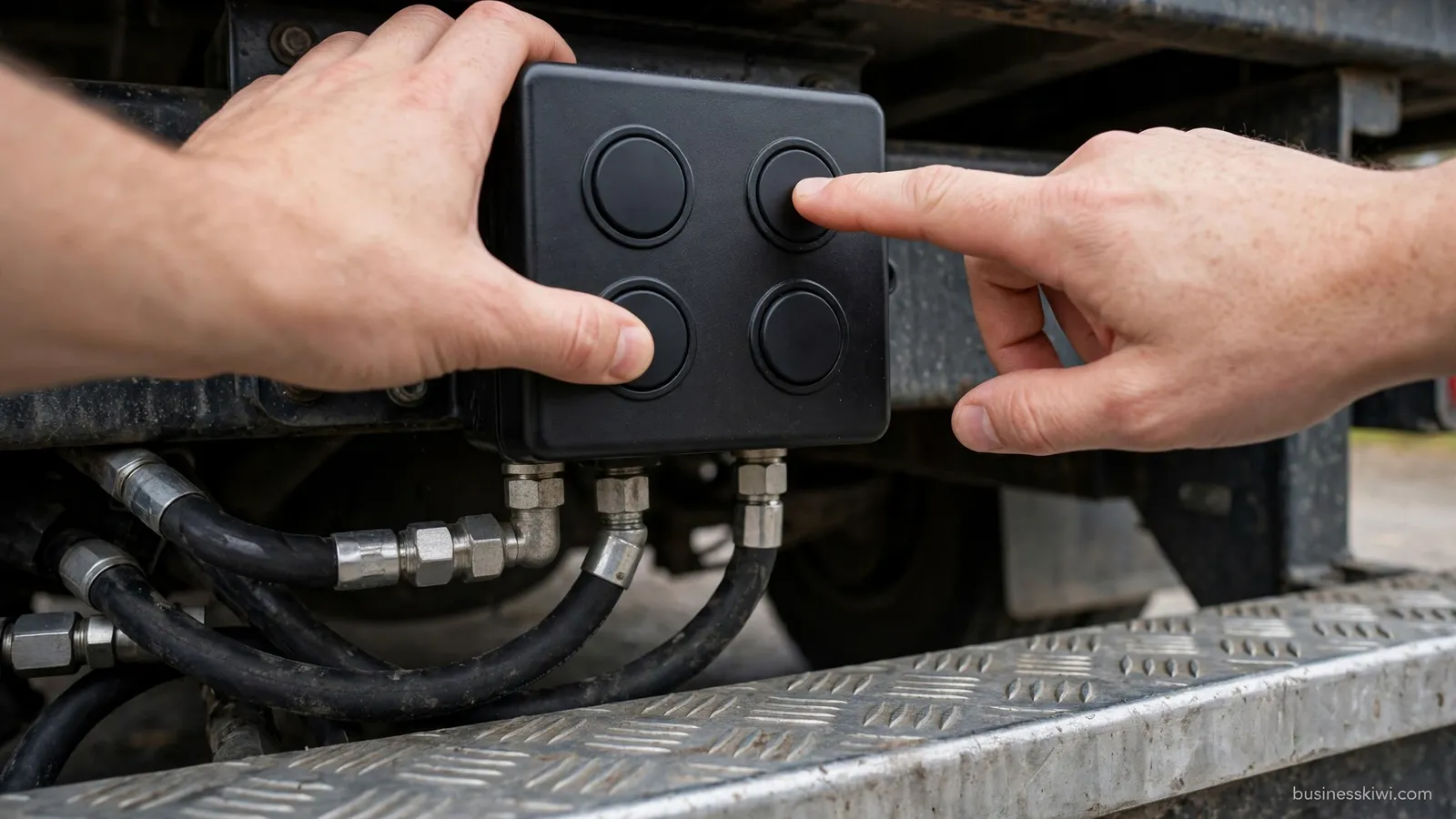
A tail lift is a hydraulic machine working outdoors in all weather, and it needs routine maintenance like any other. Palfinger New Zealand says it plainly: routine maintenance is essential for safety and for NZ compliance. No maker page read for this guide published a single fixed service interval, because intervals vary by model and duty, so the correct schedule is the one in your lift’s manual. Between services, the cheap checks are yours: oil level and leaks, damaged hoses, platform and hinge wear, controls that stick, and roll stops that no longer spring back.
Watch-outs
- Quoted prices. Makers publish capacities, not prices, and no NZ list price could be verified from an official source for this guide. Any fitted price is distributor- and vehicle-specific, so compare like with like: lift, fitting, certification and electrical work all in the quote.
- Payload amnesia. The lift’s own weight (roughly 205 kg to 505 kg across the Dhollandia models cited here) comes off legal payload. Weigh the finished vehicle if your loads run close to the limit.
- Edge loading. Ratings apply at a load centre. A heavy load at the platform edge can overload a lift that looks well within its badge figure on paper.
- Certification after the fact. On a heavy vehicle, sorting certification after fitting is slower and dearer than building it into the job. Talk to a specialist certifier first.
- Second-hand lifts. A used lift with no manual, no rating plate details and an unknown service history is a gamble. The rating and the load centre are what make the numbers meaningful, so walk away from a lift whose ratings cannot be confirmed.
Related guides: our tarpaulin guide covers securing loads on the deck, and our moving companies guide is for readers hiring movers rather than fitting a lift. For more business guides, browse the Business & Industry section.
Frequently asked questions
How much weight can a tail lift carry?
It depends on the model. Palfinger New Zealand puts most models between 500 kg and 3,000 kg. At the light end, Dhollandia’s DH-LM.10 cantilever is rated at 500 kg to 1,000 kg for vans and light trucks, while its DH-SM.20 slider is rated at 1,500 kg to 2,000 kg for medium trucks. Every rating applies at a stated load centre, so the usable figure drops as the load moves towards the platform edge.
What is the difference between a cantilever lift and a column lift?
A cantilever lift carries the platform on hinged arms and can tilt it to meet the ground, and the platform folds up to close the rear of the body. A column lift carries the platform between two vertical columns, so it travels straight up and down and stays level. Cantilevers suit general freight and uneven ground; column lifts suit tall bodies and loads that must stay upright.
Can a tail lift be fitted to a van or a ute?
Yes, within limits. Makers build light lifts specifically for commercial vans; Dhollandia’s DH-LM.10, for example, is designed for vans and light trucks up to 7.5 tonnes gross. Palfinger New Zealand also lists utes among the vehicles its lifts suit. The governing limit is payload: the lift’s weight comes off what the vehicle can legally carry, and small vehicles run out of payload quickly.
Does fitting a tail lift need certification in New Zealand?
For a heavy vehicle, NZTA Waka Kotahi requires changes to the vehicle’s structure or layout to be overseen by a heavy vehicle specialist certifier, who issues an LT400 form when the work is done to standard. A tail lift fitment commonly involves the chassis, so expect certification to be part of the job and confirm it with your installer and certifier before fitting.
How much does a tail lift cost in NZ?
This guide could not verify any NZ price from a maker’s official source, because makers and their NZ distributors publish specifications rather than list prices. Fitted cost depends on the lift class, the vehicle, electrical work and certification, so get itemised quotes from NZ installers for your exact vehicle.
How often does a tail lift need servicing?
There is no single interval that fits all models. Palfinger New Zealand states that routine maintenance is essential for safety and NZ compliance, and the correct schedule is the one in your lift’s manual, adjusted by your service agent for how hard the lift works. Between services, watch for oil leaks, hose damage, slow or drifting movement and worn roll stops.
Can a forklift still load a truck that has a tail lift?
With the right design, yes. Slider and foldable lifts stow underneath the vehicle floor, leaving the rear completely clear for forklift loading and dock work. Dhollandia describes its DH-SM.20 slider in exactly those terms. A cantilever or column lift’s platform forms part of the rear closure instead, so forklift access over it is limited.
The bottom line
A tail lift is a simple machine that repays careful buying. Choose the type by how your truck is actually loaded (kerb, dock or forklift), choose the capacity by your heaviest regular load at a realistic load centre, and count the lift’s own weight against your payload from day one. In NZ, treat fitting as part product, part compliance job: on a heavy vehicle, a specialist certifier and an LT400 are part of doing it properly. Do those things and a tail lift quietly removes the riskiest lift in your driver’s day.
Sources
- Palfinger New Zealand, How to Choose the Right Tail Lift for Your Vehicle (palfinger.co.nz)
- Dhollandia, DH-LM.10 cantilever lift datasheet, pocket guide (dhollandia.com)
- Dhollandia, DH-SM.20 slider lift datasheet, pocket guide (dhollandia.com)
- Dhollandia, DH-VO.15.K1 column lift datasheet, pocket guide (dhollandia.com)
- NZ Transport Agency Waka Kotahi, Safe loading (nzta.govt.nz)
- NZ Transport Agency Waka Kotahi, Modifying heavy vehicles (nzta.govt.nz)
- NZ Transport Agency Waka Kotahi, The Truck Loading Code: basic criteria and precautions (nzta.govt.nz)
This article is general information about tail lifts in New Zealand. It is not engineering, legal or compliance advice for a specific vehicle. Vehicle modification, certification and load security requirements depend on your vehicle and its use, so confirm the details with a heavy vehicle specialist certifier, your lift installer and NZTA Waka Kotahi guidance before fitting or operating a tail lift.