Mortgage Broker New Plymouth: What a Local Broker Does, How They Are Paid and How to Choose One

Buying a home in New Plymouth usually means borrowing a large amount of money for a long time, and few buyers arrange that loan entirely on their own. Many sit down with a mortgage broker first. In the official rules the job title is mortgage adviser, but the role is the same: an adviser who helps you find and structure a home loan, usually across more than one lender, and who is paid in a way you are entitled to have explained before you commit.
This guide explains what a broker in New Plymouth does, how brokers are paid, the licensing checks that protect you, and the local buying context you are borrowing in. It is a guide to the process, not a ranking of firms.
The short answer
A mortgage broker helps you work out what you can borrow, compares loan options from the lenders they can access, and explains how each option works, what it costs and why they recommend it. Most brokers are paid by the lender, not by you. The Financial Markets Authority (FMA) says most mortgage advisers work on commission, paid by the lender as a percentage of the loan amount when the loan is drawn down, and some also receive an ongoing commission while the loan runs. The adviser must disclose how they are paid before you proceed. Anyone giving mortgage advice must be licensed by the FMA as a Financial Advice Provider or work under one, and you can check their registration on the Financial Service Providers Register.
What a mortgage broker does
The FMA describes mortgage advice as a conversation that starts with your priorities, not with a product. Before you meet an adviser, decide what matters most in a loan. That might be the lowest overall cost, the freedom to make extra repayments, or a structure that splits the loan into parts that suit your income. A good first meeting tests those priorities against real options.
From there, the adviser’s work is comparison and explanation. Advisers often offer advice from more than one lender, and lenders are not all the same. Their rates, features and policies differ, and even a small difference in interest rate adds up over the life of a long term loan, as the FMA points out. The adviser should explain how each option works, what it will cost, and why they are recommending it. You do not have to accept the first loan you are offered. If the recommendation does not sit right, ask for an alternative and ask what it would change.
A broker should also be clear about the edges of their advice. Advisers can only advise in areas they are competent in, and they must tell you what their advice covers and what it does not. A mortgage adviser might give general information about KiwiSaver or insurance, but should refer you to a specialist if detailed advice there sits outside their competence. Finally, agree the ongoing rhythm. The FMA suggests clarifying how often the adviser will review your mortgage with you, because the loan you take today should be revisited as your income, family and plans change.
How brokers are paid, and the disclosure you must receive
Most mortgage advisers in New Zealand work on commission. The FMA explains that this is a payment from the lender, calculated as a percentage of the total loan amount, and paid when you draw the loan down, for example at the purchase of a house. Some advisers also receive an ongoing periodic commission from the lender for as long as you hold the loan. The FMA does not publish a standard percentage, and commission is not the same at every lender. It varies, which is worth knowing because a varying commission could in theory influence a recommendation. Against that, advisers are required to prioritise your interests over their own, and you can ask about the commission structure directly.
Commission is not the only model. Sometimes an adviser charges you a fee directly, instead of commission or as well as it. Where a mortgage is successfully arranged, the FMA notes there is generally no upfront fee, because the lender pays the adviser. If a fee might apply in your case, you are entitled to know about it early, not at settlement.
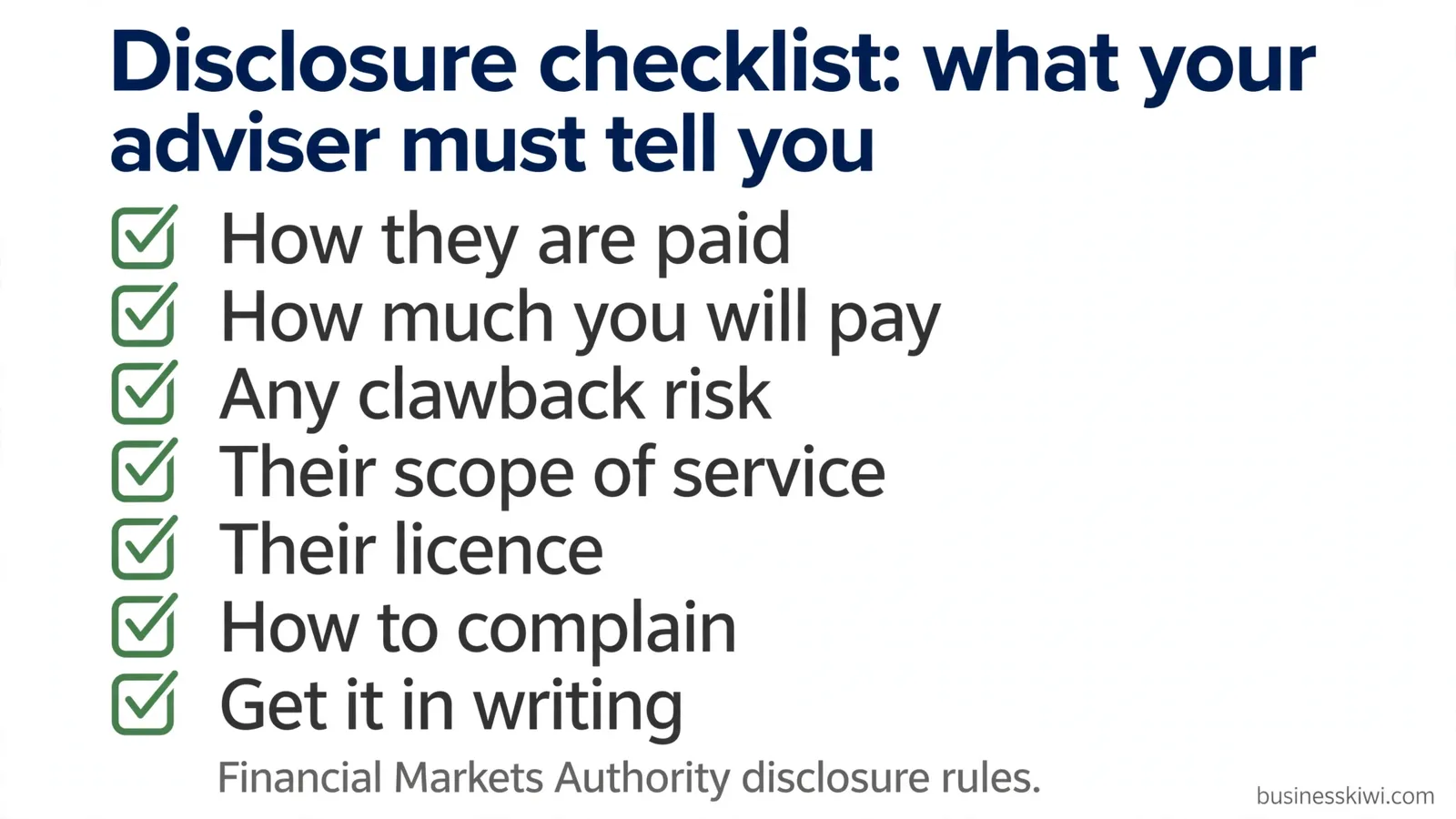
That entitlement is the disclosure regime, and it is the part of the system designed to protect you. Advisers are required to disclose how they are paid, how much you will need to pay, and the circumstances in which a fee, or an additional fee, would arise. An adviser must also take reasonable steps to disclose all fees and costs associated with the advice, presented in a clear, concise and effective way. The FMA encourages you to ask for the costs clearly in writing. Treat that as normal practice rather than an awkward request. If you are unsure whether you are getting a good deal, the FMA’s advice is simple: ask around, and compare what other mortgage advisers charge.
Broker or bank: the short version
Going direct to your own bank is the other main route, and it is a legitimate one. The practical difference is range. A bank can only offer its own loans. A broker can usually put more than one lender’s options in front of you, although the exact range depends on that adviser’s arrangements, so ask which lenders and products they can advise on. Neither route removes your homework: you should understand the loan’s cost, features and conditions before you sign either way. We have covered this comparison in depth in our separate guide to using a mortgage broker or going direct to a bank, so this local guide keeps the section short.
Choosing a broker in New Plymouth

Start with the register, not with advertising. Financial advice is regulated by the FMA, and those providing it must be licensed as a Financial Advice Provider or operate under a provider’s licence. The Companies Office keeps the Financial Service Providers Register, known as the FSPR, which lists licensed Financial Advice Providers and the financial advisers who work for them. Enter the adviser’s name on the register to check who they are engaged by. If someone offering mortgage advice does not appear, that is your answer.
Advisers must also follow the Code of Professional Conduct for Financial Advice Services, which sets standards for conduct, client care, competence, knowledge and skill. You cannot read competence off a register entry, so the FMA suggests treating the first meetings as interviews. Meet a few different advisers before choosing. Notice whether the adviser explains their competence, knowledge and skill, what type of licence they hold or whose licence they work under, and the types of products they can advise on, including the limits of their service. Check that they tell you how they are paid, whether through fees from you or commissions from product providers. Ask how you can complain if something goes wrong, and which dispute resolution service they belong to.
Many people find an adviser through a referral from friends or family, and the FMA says that is common. It also counsels doing your own homework anyway. A friend’s circumstances will differ from yours, and good advice often only proves itself years later. Ask the adviser for examples of how they have helped people in a situation similar to yours. For a New Plymouth purchase, relevant experience might include a first home in Waitara or Inglewood, a new build in a growth subdivision, a family home in the city suburbs, or a lifestyle block on the rural fringe. The point is whether the adviser understands the kind of purchase you are making. Professional association websites, such as Financial Advice New Zealand, also list advisers if you want a wider field.

Buying in New Plymouth: the local context
New Plymouth District is a growing district, and that shapes what you will be buying and borrowing for. The district council’s draft Future Development Strategy, published for consultation in March 2024 by New Plymouth District Council and Taranaki Regional Council, puts the district’s population at around 89,000 and projects roughly 98,800 people by 2034 and about 110,400 by 2054. On the council’s numbers, the district needs an average of about 368 additional houses a year over the next 30 years, and the draft strategy provides capacity for about 11,355 new houses against projected demand of about 11,027 homes by 2054.
The pattern matters to buyers. Over the five years covered by the strategy document, around half of new dwellings were built in the residential areas of New Plymouth city, about a fifth in Bell Block, and the rest in the smaller townships and rural areas. The councils’ preferred approach is a balance: more intensive housing in and around the city centre, town centres such as Waitara, Inglewood and Fitzroy, and along key transport routes, alongside infill housing and staged greenfield subdivisions on the fringes of existing areas. Bell Block is expected to keep producing a high number of new homes in the short to medium term, helped by its structure plan area and undeveloped residential land.
A New Plymouth buyer might be looking at an established house in the city suburbs, a home in a township, a new build in a growth area, or a lifestyle block, and the council expects demand for smaller homes, larger intergenerational homes and more affordable housing to grow as the population ages and diversifies. None of that changes how a broker is paid or regulated. It changes the conversation you have. The loan features that matter for a new build, a first home or a downsize are different, which is why the FMA puts your priorities at the start of the advice process. This guide deliberately gives no local price figures: the borrowing process described here does not depend on them, and current price statistics belong to official statistical releases.
The process, step by step
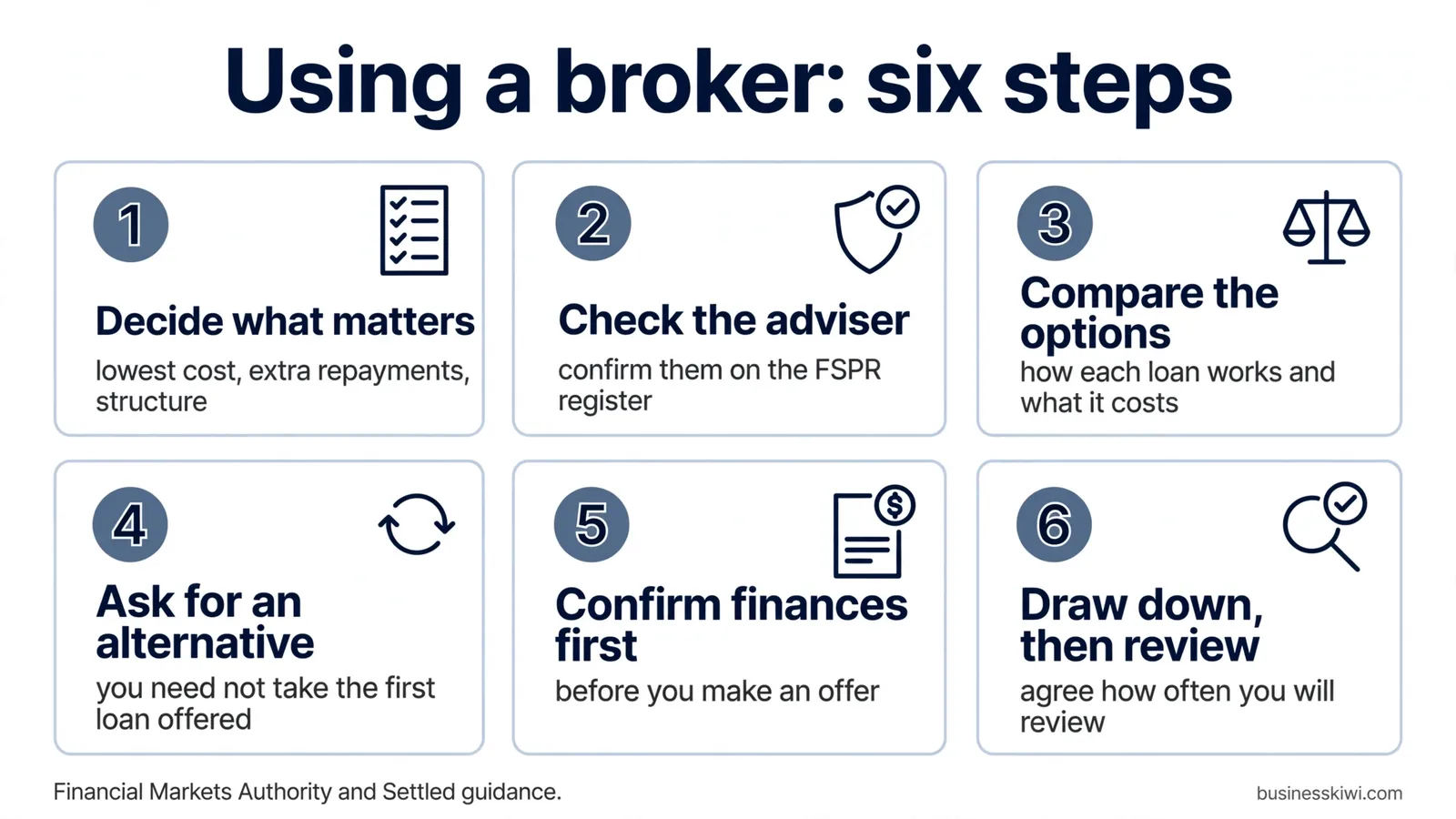
Step one is preparation. Decide what you want from the loan and gather the basics of your income, spending, debts and deposit. Settled, the Real Estate Authority’s consumer site, makes the same point from the buying side: set clear goals, start looking at your finances, and build your support team early. That team typically includes your lawyer or conveyancer and, if you choose one, your broker.
Step two is the first adviser meeting. Check the adviser’s registration on the FSPR, listen for the disclosure about how they are paid and what their advice covers, and ask your questions.
Step three is comparison. The adviser presents loan options and explains how each works, what it costs and why they recommend one over the others. Ask for an alternative if the first recommendation does not suit you. Small rate differences compound over a long loan, so this is the stage where care pays.
Step four is confirming your finances before you commit to a property. Settled stresses confirming your finances before making an offer, and understanding the sale and purchase agreement, because it is legally binding. Alongside the finance, do the property homework: read the official documents, consider a LIM and a property inspection, and take legal advice before you sign.
Step five is the purchase itself. Your offer is accepted, conditions are worked through, and the loan is drawn down at settlement, which is the point at which the lender pays the adviser’s commission. Step six is the part people forget: the review. Agree with your adviser how often you will revisit the mortgage, so the loan keeps fitting your life.
Watch-outs worth knowing
Clawback is the least understood cost in broker-arranged lending. If your loan ends, or you move it to another lender, within a certain period, the lender may reclaim some or all of the commission it paid your adviser. The FMA does not set a single period, because it depends on the lender’s terms. In some cases the adviser may then charge you a fee. The protection is timing: the adviser must tell you upfront if a clawback fee could be charged to you. Ask the question directly if it is not raised, especially if you think you might sell, refinance or restructure within a few years.
Cashback offers are a separate trap, and the two are easily confused. Lenders sometimes offer a cash incentive with a new loan, but short term incentives can carry lock-in clauses lasting a number of years, and moving lenders can mean repaying some or all of the cash. A cashback repayment and a commission clawback are different things, and leaving early can trigger both. The FMA’s guidance is to check that the long term fundamentals of the loan stack up, rather than letting an upfront incentive decide a decades long commitment.
Two smaller watch-outs complete the picture. First, scope: if your adviser starts discussing KiwiSaver or insurance in detail, they should only advise where they have the competence to do so, and may refer you elsewhere. Second, pressure: nothing in the process requires you to take the first offer, first adviser or first loan structure you are shown. The system is built around disclosure and comparison. Use both.
Related guides: keep an eye on current home loan rates as you compare offers. For more money guides, browse the Finance section.
Frequently asked questions
Do I pay a mortgage broker in New Plymouth myself?
Usually not upfront. In most cases the lender pays the broker a commission when your loan is drawn down, and the FMA notes there is generally no upfront fee where a mortgage is successfully arranged. Some advisers charge a fee instead of commission, or as well as it, and a fee can arise in specific situations such as a clawback. Whatever the model, the adviser must disclose how they are paid and how much you will need to pay.
How much commission will the broker earn from my loan?
The FMA describes commission as a payment from the lender calculated as a percentage of the total loan amount, sometimes with an ongoing periodic commission on top. The FMA does not publish a standard percentage, and the amount varies between lenders. Your adviser has to disclose how they are paid, so ask them to set it out clearly, and get the costs in writing.
How do I check that a broker is licensed?
Search the adviser’s name on the Financial Service Providers Register, which is kept by the Companies Office. The register lists licensed Financial Advice Providers and the advisers engaged by them, so you can confirm the adviser’s registration and see who they work under. Advisers must be licensed by the FMA as a Financial Advice Provider or operate under a provider’s licence.
Which lenders can a broker access?
It depends on the adviser. The FMA notes that advisers often offer advice from more than one lender, but the range is set by each adviser’s own arrangements and the products they are able to advise on. Ask the adviser which lenders and products their service covers, and what it leaves out. An adviser must be upfront about the scope of their service, and that answer tells you how wide your comparison really is.
When in the buying process should I see a broker?
Early, and certainly before you make an offer. Settled, the Real Estate Authority’s consumer site, advises buyers to sort their finances and build their support team at the thinking stage, and to confirm their finances before making an offer on a property. Starting early also gives you time to compare advisers and loan options without a deadline pressing on you.
What is a clawback fee, and could I be charged one?
If your loan ends or moves to another lender within a certain period, the lender may reclaim some or all of the commission it paid the adviser. In some cases the adviser can pass a fee on to you. The FMA does not specify one period, since it varies by lender. What is fixed is the adviser’s duty: they must tell you upfront if a clawback fee could apply to you, so you can factor it into any decision to refinance or sell early.
Can I go direct to my bank instead of using a broker?
Yes. Using a broker is a choice, not a requirement. A bank will offer you its own loans, while a broker can usually compare options from more than one lender. Either way, the same discipline applies: understand what the loan costs, what features it has, and what conditions attach to it. Our separate guide compares the two routes in depth.
The bottom line
A mortgage broker in New Plymouth does three things: helps you clarify what you need from a loan, compares options across the lenders they can access, and explains the recommendation so you can judge it. You are protected by a licensing and disclosure regime run by the FMA, and the key checks cost nothing: confirm the adviser on the Financial Service Providers Register, insist on clear disclosure of how they are paid, and ask about clawback before you sign. Do that, and a broker’s local knowledge of a growing district of city suburbs, townships and new subdivisions becomes a genuine advantage rather than an act of faith.
Sources
- Financial Markets Authority, Mortgage advice, https://www.fma.govt.nz/consumer/getting-advice/mortgage-advice/
- Financial Markets Authority, Getting advice, https://www.fma.govt.nz/consumer/getting-advice/
- Financial Markets Authority, How do I find an adviser?, https://www.fma.govt.nz/consumer/getting-advice/finding-an-adviser/
- Settled (Real Estate Authority), Buying a home, https://www.settled.govt.nz/buying-a-home/
- New Plymouth District Council and Taranaki Regional Council, Statement of Proposal: Draft Future Development Strategy for Ngāmotu New Plymouth, March 2024, https://www.npdc.govt.nz/media/djylmbyc/ecm_9179551_v7_statement-of-proposal-march-2024-draft-future-development-strategy.pdf
This article is general information about using a mortgage broker in New Plymouth and how mortgage advice is regulated in New Zealand. It is not personalised financial advice and does not recommend any particular broker, lender or loan. Figures about the district’s growth are projections from New Plymouth District Council’s draft Future Development Strategy (March 2024) and may change as that strategy is finalised. Before making decisions about a home loan, consider speaking with a licensed financial adviser about your own circumstances.