How Many Retirement Villages in NZ: The Count, the Register and How to Check a Village
The short answer
New Zealand has just under 500 retirement villages. The exact number depends on which count you use, because no government agency publishes a single running total.
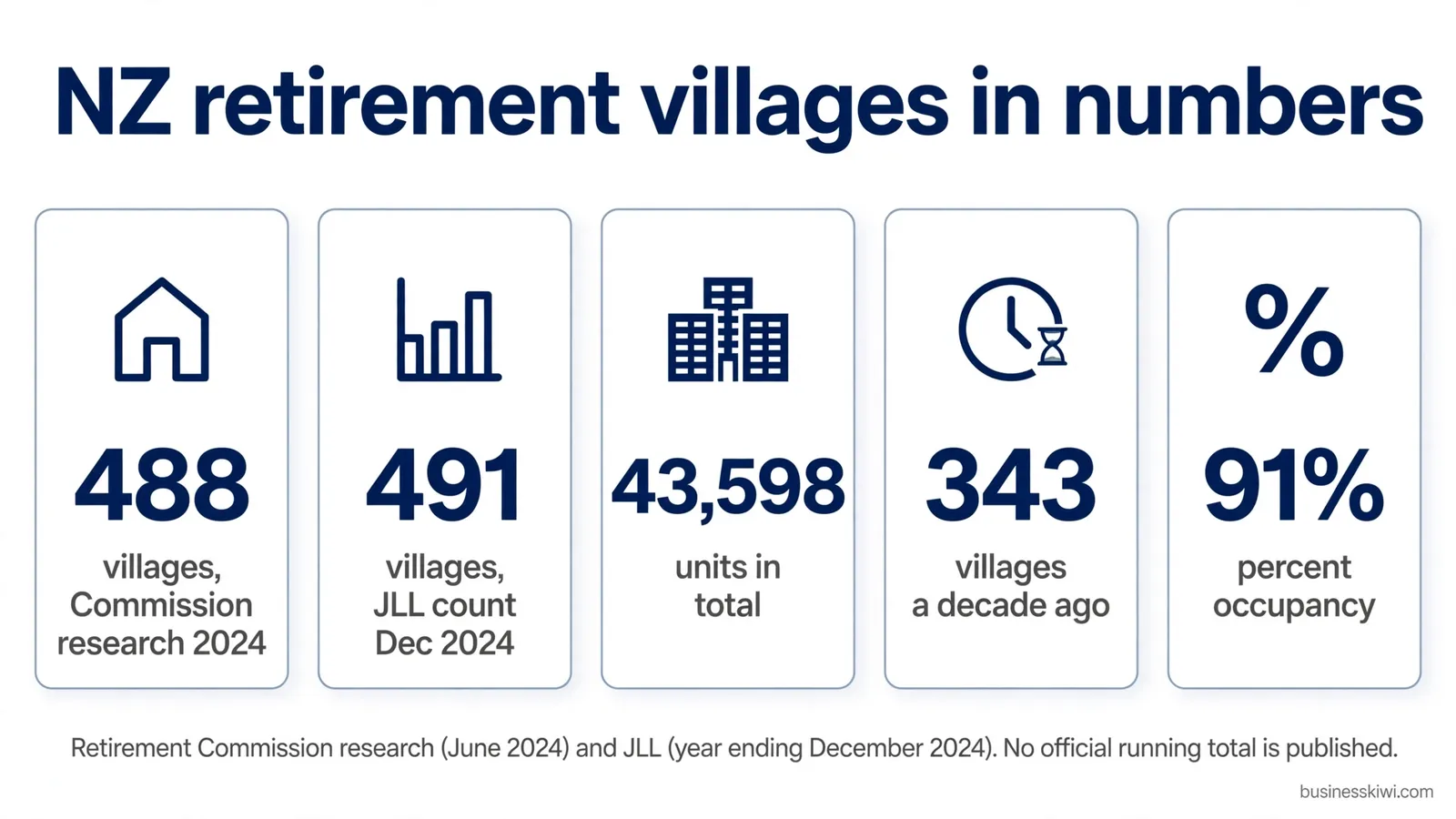
The most recent figure published by Te Ara Ahunga Ora Retirement Commission comes from research it commissioned from BERL, released in June 2024. That research put the number of retirement villages in New Zealand at 488.
Industry research tells a similar story. JLL, which maintains the New Zealand Retirement Village Database, counted 491 villages at the end of December 2024, with 43,598 units between them.
The authoritative list sits behind both numbers. Every retirement village must be registered on the Retirement Villages Register, held by the Companies Office, and anyone can search that register free of charge. It is searchable village by village rather than published as a headline total, which is why the counts you see quoted come from research snapshots instead.
What is not in doubt is the direction of travel. JLL counted 343 villages a decade ago, so the sector has added roughly 150 villages in ten years, and new villages are still being built. This article explains what counts as a retirement village in law, how registration works, how to check a village yourself, and what the sector looks like in numbers.
What counts as a retirement village in New Zealand law
Retirement village is a legal term, not just a marketing label. Section 6 of the Retirement Villages Act 2003 sets out the features a place must have before the Act applies to it, and the Companies Office explains the definition this way.
A retirement village has two or more residential units. Those units can be villas, apartments, studio units, kaumatua flats or even a room in a rest home, as long as the place was built as, or is now mainly used as, accommodation.
It provides residential accommodation together with services or shared facilities, or both. A block of ordinary apartments with no shared facilities or services sits outside the definition.
It is mainly for people in their retirement, including their spouses or partners.
Residents pay a capital sum for their right to live there. That payment can be a lump sum or instalments, as long as it is substantially more than rent for the same period would be.
Two points catch people out. First, the name does not matter. A development marketed as a lifestyle village or retirement community is still a retirement village in law if it has those features. Second, the legal form does not matter either. Whether a resident’s right is structured as a licence to occupy, a unit title or a lease, the Act’s protections apply in the same way.
If a place meets the definition, registration is not optional. The operator must make sure the village is registered, and it cannot offer places or advertise the village unless it is registered, apart from limited exceptions the Act allows.
Registration and the rules every village works under
New Zealand runs one national system. The Retirement Villages Act 2003, the Retirement Villages Regulations 2006 and the Code of Practice 2008 set the rules, and the Retirement Villages Register, administered through the Companies Office, is where every village is recorded.
Registration does several jobs at once. It makes the village visible to the public. It also triggers the protections the Act builds around residents. A statutory supervisor must be appointed for each village, unless the operator holds an exemption, to watch over residents’ interests. A memorial is registered against the title to the village land, so the village cannot simply be wound up over residents’ heads. And the operator must work within the Code of Practice, which sets minimum operating standards for every village.
Residents get a Code of Residents’ Rights as well. It covers the services and benefits promised in their agreement, the right to information about anything that affects their residency, the right to be consulted about changes, and the right to complain through a set disputes process.
Before anyone signs, the law requires proper paperwork and independent advice. The operator must provide a disclosure statement and an occupation right agreement, and an intending resident must discuss the key documents with a lawyer experienced in retirement village work before signing. That legal advice step is compulsory, not a suggestion.
Oversight sits with two bodies. The Registrar of Retirement Villages looks after the register itself. Te Ara Ahunga Ora Retirement Commission has a statutory job of monitoring how the Act is working, and it reports on the sector and receives the pattern of formal complaints, which operators must report every six months.

How to check whether a village is registered
Checking a village takes a few minutes and costs nothing. The Retirement Commission sets out the steps on its website.
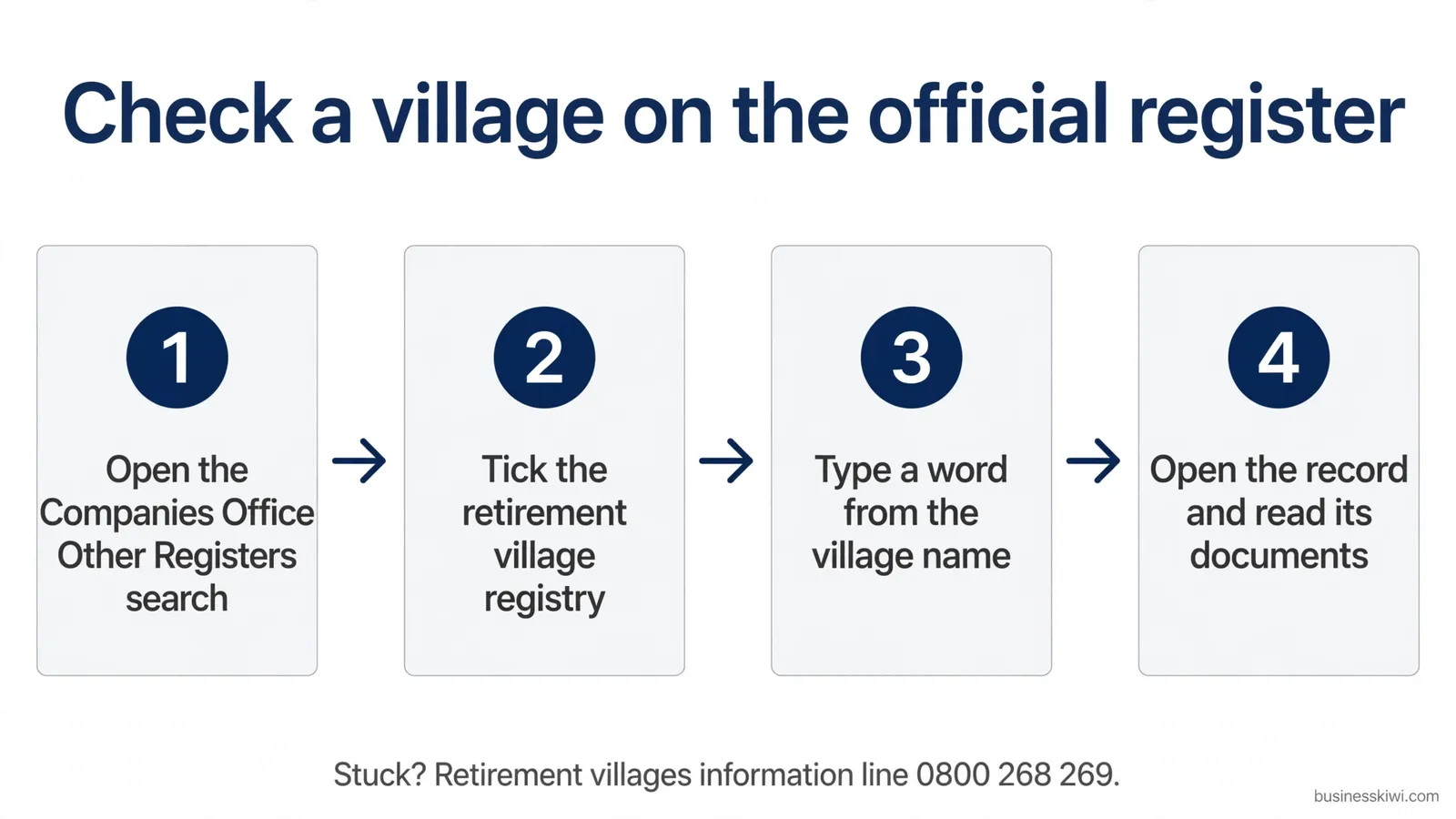
Start on the Companies Office website and choose the option to search the Retirement Villages Register, then the Other Registers search. Tick the retirement village registry, then type a word from the name of the village. If the village is registered, its name appears. Selecting it shows the documents recently registered for that village, including its annual return and the current versions of its disclosure statement and occupation right agreement.
Three checks are worth making. First, confirm the village appears on the register at all. A village that meets the legal definition but is not registered is a serious red flag, because the operator is not allowed to offer or advertise places in it.
Second, look at whether the documents match what you have been given. Operators update their disclosure documents from time to time, and the register holds the latest versions, so you can see if the paperwork in front of you is current.
Third, ask the operator to show you proof that the village is registered and that its registration has not been suspended or cancelled. The Commission says operators can provide this, and a well run village will not hesitate.
If the search defeats you, the retirement villages information line on 0800 268 269 can help. If the village belongs to the Retirement Villages Association, you can also ask whether its membership is provisional or fully accredited. Association membership is voluntary and separate from registration, but accredited members must be lawfully registered and meet the Association’s audit requirements.
The sector in numbers
Retirement villages are a bigger part of New Zealand housing than most people realise. BERL’s research for the Retirement Commission found that New Zealand has more retirement villages per head of population than any other country in the world. Around 5 percent of New Zealanders aged over 65 live in a village, and the share rises to about 14 percent of people aged over 75.
The idea is not new here. The country’s first retirement village, Selwyn Village in Point Chevalier, Auckland, opened in 1954. Growth since then has been steady, and it has sped up over the last decade.
JLL’s database, which tracks villages across the country, shows how fast the sector is still moving:
- Villages: 343 a decade ago, 491 at the end of 2024.
- Units: 43,598 at the end of 2024, roughly double the number of a decade earlier.
- Occupancy: about 91 percent, which JLL describes as consistent.
- Demand: JLL projects a possible shortfall of more than 23,000 units by 2048 if building does not keep pace with the growing population aged 75 and over.
Demand is not spread evenly. JLL reports the strongest interest in Auckland, Canterbury, the Bay of Plenty and Nelson Marlborough, where operators are expanding existing villages as well as buying new sites.
How people hold their homes in villages is also consistent. A licence to occupy accounts for about 95 percent of occupation rights, according to a 2023 Martin Jenkins paper cited in the Commission’s 2024 report. Unit titles, cross leases and leases for life make up most of the rest. Under a licence to occupy you buy the right to live in the unit. You do not own the unit or the land under it.
Retirement villages, rest homes and other options
The most common mix-up is between retirement villages and rest homes. They are different things, run under different rules.
A retirement village is housing first. Residents live independently in their own unit and use the services and facilities the village offers. Moving in is a lifestyle decision, made while you are able to live independently.
Residential care is care first. A rest home, private hospital or dementia facility looks after people with high dependency needs who have been needs assessed as requiring long term care. The Retirement Commission is clear that care facilities are separate operations from retirement villages and work under different legislation, even when they sit on the same site.
Many villages do have a care facility on site or next door. That can make the move into care shorter when the time comes, and village residents often get priority access, subject to eligibility and availability. But the care itself is a separate arrangement with its own costs, and a serviced apartment inside a village, with meals, cleaning and support bundled in, still sits on the village side of the line until a needs assessment says otherwise.
The other labels you will see are softer. Lifestyle village is a marketing term rather than a legal category. If the development offers accommodation with services or facilities to mainly retired people for a capital sum, it falls inside the Act’s definition and must be registered, whatever the sign at the gate says.
Villages are also only one option. Some people downsize to a smaller home, some stay in their own home and bring in support, and councils and community providers offer pensioner housing in some areas. The right comparison is not village against village alone. It is village life against the realistic alternatives for the years ahead.
What the money looks like, in brief
Village finances follow a pattern, even though every village sets its own numbers. There is a capital sum to enter, which buys your occupation right. There are weekly or monthly fees while you live there, covering things like rates, insurance, maintenance and the services the village provides. And when you leave, a deferred management fee is deducted before the balance of your capital sum is repaid to you or your estate.
Two features surprise people. Most residents do not share in any capital gain when their unit is resold, because they never owned the unit. And the repayment usually waits until the unit is resold to a new resident, because the operator controls that sale.
The detail lives in each village’s disclosure statement and occupation right agreement, and it varies enough between villages that comparing paperwork matters more than comparing brochures.

What to check before you choose a village
Sorted, the Retirement Commission’s money guidance service, gives one piece of advice above all others: do not rush. Its checklist for choosing a village covers the ground well.
Think ahead. Consider what you might need in five or ten years, and whether the village can still work if your health or mobility declines, including whether care is available on site.
Visit more than one village. Compare housing types, facilities and services, and spend time in the place rather than relying on a tour alone.
Talk to residents. They know what daily life in the village is really like, including how the operator handles problems.
Read the documents properly. The disclosure statement, the occupation right agreement, the Code of Practice and the Code of Residents’ Rights are the contract you will live under. Ask for the key terms disclosure summary, which sets out the main financial terms in plainer language.
Find out the total costs. What is payable on entry, what the ongoing fees cover, what is deducted when you leave, whether you share any capital gain or carry any capital loss, and how all of that affects your wider plans.
Do the register check described above, and ask the operator for proof of registration.
Take independent advice. The Act requires you to take legal advice from a lawyer experienced in retirement villages before you sign, and independent financial advice is worth having as well, especially if you are releasing equity from your home or rearranging investments to fund the move.
Involve family or friends. A second pair of eyes helps, and the people closest to you will often be involved when you eventually leave the village.
Related guides: our full retirement villages guide covers the Act, fees and exit rules in depth, and our guide to planning for retirement covers the wider money picture. If the move means rearranging savings or investments, our financial planner guide explains how advisers work. For more money guides, browse the Finance section.
Frequently asked questions
How many retirement villages are there in New Zealand?
Just under 500. Research published by Te Ara Ahunga Ora Retirement Commission in June 2024 put the number at 488. JLL’s industry database counted 491 villages at the end of December 2024. No agency publishes a single official running total, because the Retirement Villages Register is a searchable list rather than a published tally, so dated research counts like these are the best public figures.
Is there an official list of retirement villages in NZ?
Yes. The Retirement Villages Register, administered through the Companies Office, records every registered village. You can search it free on the Companies Office website by entering a word from the village’s name. Each entry shows the village’s recently registered documents, including its annual return and its current disclosure documents.
Does a retirement village have to be registered?
Yes, if it meets the legal definition in the Retirement Villages Act 2003. The operator must ensure the village is registered, and it must not offer occupation rights or advertise the village unless it is registered, apart from limited exceptions allowed by the Act. Registration applies whatever the development calls itself.
What is the difference between a retirement village and a rest home?
A retirement village is independent housing with services and shared facilities, chosen as a lifestyle move. A rest home is residential care for people with high dependency needs who have been needs assessed as needing long term care. Care facilities are separate operations under different legislation, although many villages have one on site or next door.
Do you own your home in a retirement village?
Usually not. About 95 percent of occupation rights are licences to occupy, which give you the right to live in the unit without owning the unit or the land. Unit titles, cross leases and leases for life exist but are much less common. Your occupation right agreement sets out exactly what you hold.
What does it cost to live in a retirement village?
Costs come in three stages: a capital sum on entry, weekly or monthly fees while you live there, and a deferred management fee deducted from your repayment when you leave. Amounts vary widely between villages, and most residents do not share in any capital gain. The full figures for a village are set out in its disclosure statement, which you should read with your lawyer before signing.
Where can I get independent help before signing up?
Start with Sorted and the Retirement Commission, which publish free guidance, and the retirement villages information line on 0800 268 269. Before you sign an occupation right agreement, the Act requires independent legal advice from a lawyer experienced in retirement village work. Independent financial advice is also sensible if the move affects your savings, investments or estate plans.
The bottom line
New Zealand has just under 500 retirement villages, the count is still rising, and the country has more of them per head of population than anywhere else. Because no official running total is published, the numbers worth trusting are the dated research counts: 488 in the Retirement Commission’s June 2024 research, and 491 in JLL’s database at the end of 2024. For any individual village, skip the estimates and go to the source. The Retirement Villages Register will tell you whether it is registered, and its filed documents will tell you what you are actually signing up to.
Sources
- Companies Office, What a retirement village is: https://www.companiesoffice.govt.nz/all-registers/retirement-villages/about-the-register/what-a-retirement-village-is/
- Companies Office, Retirement Villages Register: https://www.companiesoffice.govt.nz/all-registers/retirement-villages/
- Te Ara Ahunga Ora Retirement Commission, Resources for retirement village residents: https://retirement.govt.nz/retirement-villages/resources-for-retirement-village-residents
- Te Ara Ahunga Ora Retirement Commission, Resources for the retirement village industry: https://retirement.govt.nz/retirement-villages/resources-for-the-retirement-village-industry
- BERL for Te Ara Ahunga Ora Retirement Commission, Retirement Villages: International Scan of Operating Models (June 2024): https://assets.retirement.govt.nz/public/Uploads/Policy/AnnualInvestigationInternationalScan_June2024.pdf
- Sorted (Te Ara Ahunga Ora Retirement Commission), When you’re thinking of living in a retirement village: https://sorted.org.nz/guides/choosing-a-retirement-village
- JLL, Perspectives on New Zealand’s retirement villages (2025, data for the year ending December 2024): https://www.jll.com/en-au/insights/retirement-villages-market-review
This article is general information about retirement villages in New Zealand and how the sector is counted, registered and regulated. It is not personal financial or legal advice. Village numbers change as villages open, expand and close, so treat every figure here as dated to its source. If you are considering a move, check the village on the Retirement Villages Register, read its disclosure statement carefully, and take independent legal advice before signing an occupation right agreement, as the Retirement Commission recommends and the Retirement Villages Act requires.