Buying an Accounting Practice in NZ: What You Are Really Paying For

Buying an accounting practice looks simple from the outside. One accountant retires, another steps in, the clients stay, and the fees keep coming. In practice, what changes hands is far less solid than a shop full of stock. You are mostly buying relationships, habits and trust, and none of those come with a guarantee that they will still be there in twelve months.
That is why a practice purchase rewards slow, careful work. The seller knows which clients pay promptly and which only stayed because they liked the person leaving. This guide explains what is actually being bought, how sales are structured in principle, how to think about value without pretending there is a standard price, what to check before you commit, and the professional rules you must meet to serve those clients, deal with Inland Revenue, and handle client information lawfully.
Nothing here replaces your own advice. A purchase of this kind needs a lawyer, an independent accountant acting for you alone, and a valuer experienced in professional practices.
What you actually buy
The core asset is the client base and its recurring work: annual financial statements and tax returns, GST returns, payroll support and regular reporting for a stable group of clients. Recurring compliance work is prized because it repeats. A client who has filed through the same practice for ten years, on the same cycle, with fees paid on time, is a very different proposition from one who arrived last year for a one-off tidy-up. Assessing a practice means assessing how much of its income is likely to repeat, at a similar margin, under new ownership.
One-off work, such as business sales or catch-up filing, sits alongside it. It can be profitable but does not repeat, so separate it out before forming a view on value.
Staff are the second major piece. In many practices clients deal mainly with a senior accountant or trusted administrator, not the owner. If those people stay, continuity is plausible. If they leave, the relationships may leave with them. Staff are free to resign, but who prepares the work, who reviews it, and who the client rings first with a problem tells you where the goodwill really sits.
Systems and records come next: practice management software, document storage, templates, and file quality. Tidy files and a current database reduce your cost to serve each client; messy files do the opposite and can hide risk. Establish which licences transfer and what the same tools will cost you.
Two further items need careful definition. Work in progress means jobs started but not yet billed at settlement. Debtors means invoices issued but not yet paid. Sometimes the buyer pays for agreed work in progress and completes the jobs; sometimes the seller finishes their own work. Debtors may stay with the seller or pass to the buyer at a discount for non-payment risk. There is no single correct approach. What matters is that the agreement states it precisely, with a cut-off date, a valuation method for partly finished jobs, and a rule for money arriving after settlement for work done before it.
The practice name and reputation also carry value. Confirm what branding rights transfer, who owns the domain and client database, and whether the seller keeps any related name that could confuse clients. The lease matters too: its term, outgoings, landlord consent, and whether the location still suits clients and staff.
How these sales are usually structured
Business.govt.nz, the government business guidance service run by the Ministry of Business, Innovation and Employment, describes buying an existing business as a way to gain customers, premises, existing contracts and staff without building from scratch. It advises buyers to research the business and its market, register their interest with the person managing the sale, get a lawyer or accountant to check the details and represent them, and ask the owner why they are selling, comparing the answer with the sales documents. Each step applies to a practice purchase. Retirement after a long career is a different risk profile from a hurried sale after losing a major client, and the documents should support the story you are told.
In principle, practice sales take one of two broad shapes. The first is a sale of the whole practice: the buyer takes over the client base, staff, systems, premises arrangements and name, and the practice continues as a going concern. The second is a sale of a block of fees: the seller keeps part of the practice and sells a defined portion, often the smaller compliance clients. A block-of-fees purchase can suit a sole practitioner wanting growth without an office or full team. It also concentrates the retention question, because the clients being sold are sometimes the ones the seller least wants to keep. Ask why that block is for sale.
There is also a structural choice. In an asset purchase, the buyer acquires specific assets, such as goodwill, client relationships, equipment and agreed work in progress, while the seller’s entity remains behind with its history and liabilities. In a share purchase, the buyer acquires shares in the company operating the practice, so the company continues with the same contracts, Inland Revenue registrations and obligations, under new owners. Business.govt.nz notes that different structures carry different legal and financial obligations, that a sole trader is personally responsible for income and losses, and that a company separates business and personal finances. An asset purchase lets the parties define exactly what transfers. A share purchase is simpler for continuity but means inheriting the company’s past, including any tax or employment problems diligence has not found. Which route suits you is a question for your lawyer and your own accountant early, not at the last minute.
Whatever the shape, the terms belong in a written sale and purchase agreement prepared or reviewed by your lawyer, covering the parties, what is included and excluded, the price and payment terms, work in progress and debtors, the seller’s warranties, the handover period, and any restraint on the seller. If a promise matters, it needs to be in the document.

Valuation as principles, not prices
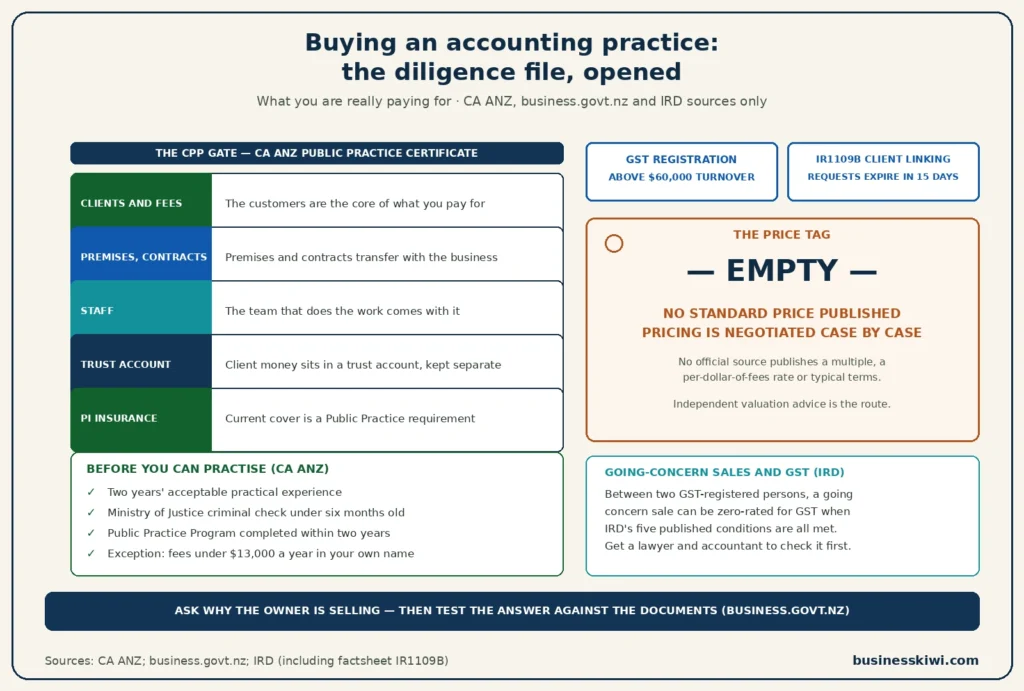
This is where many buyers go looking for a formula, so it needs to be stated plainly. No official New Zealand source publishes a standard price for an accounting practice, a set value for each dollar of fees, or typical payment terms for these sales. Pricing is negotiated case by case, based on the particular clients, staff, location and risks. Anyone quoting a going rate without examining the practice in front of you is offering a shortcut, not a valuation. Get independent valuation advice based on the actual records, and focus your own effort on what drives value.
The first driver is the quality of the recurring fees. Look at fee income over several years, not one. Is it stable, growing or drifting down? How much is repeat compliance work, and how much is one-off? Are fees spread across many modest clients, or does a small number of large clients account for a big share? Losing one large client after settlement can remove a serious slice of the income you paid for. A long tail of very small clients spreads that risk, yet each one still needs the same onboarding and annual attention, so the cost to serve can erode the margin.
The second driver is retention risk. Clients are free to leave at any time. They stay because of trust, habit, service quality and price. Retention is strongest where the relationship is with the practice and its staff, fees feel fair, and the handover is personal and early. It is weakest where the departing principal was the whole relationship, fees have been held artificially low and need to rise, or clients learn of the sale from someone else. Model the purchase on the assumption that some clients will leave, because some almost always do.
The third driver is dependence on the departing principal. If the seller personally does most of the work, holds most of the technical knowledge, and is who clients ring, you are not just buying a practice. You are buying a demanding job, plus serious risk while relationships transfer. Documented systems, work spread across capable staff, and a seller willing to stay through a structured handover make the income more likely to survive the change, and the practice worth more.
A valuer will typically want several years of financial statements and fee records, an aged debtor list, work in progress records, a client list analysed by fee size, service type and length of relationship, staff costs, the lease, and any claims history. They will also test true earnings after allowing a market-level salary for the owner’s work. A practice can look profitable only because the principal works long hours for modest drawings, and pricing that labour properly is the difference between buying a business and buying an expensive job.
Due diligence: what to check before you sign
Due diligence is the structured checking you do before you become legally committed, or within a conditional period your lawyer builds into the agreement. For a practice it has a financial layer, a client layer and a professional risk layer.
On the financial side, work through the practice’s accounts and tax returns for several years and reconcile fee income with practice management reports and bank records. Look at the trend, the mix of work, and write-offs, which can reveal fee setting or client quality problems. Examine debtors by age and by client. Old debts often signal disputes, and a client who owes the seller money may not be the loyal recurring client the fee list suggests. Review larger work in progress items job by job and ask how they were valued.
On the client side, ask for an anonymised analysis first, then identified detail once confidentiality arrangements are in place. You want client numbers, length of relationship, services taken, fees paid, and whether engagement letters are current. Engagement letters define what the practice has agreed to do, and gaps create risk. Check also for higher-risk clients, such as cash-intensive businesses, overdue filings or disputes with Inland Revenue, and for concentration in a single industry under pressure.
On the professional side, ask about professional indemnity insurance: the insurer, the cover, whether it is current, and the claims and notifications history. Ask directly about complaints to the professional body, practice review findings, and any conditions on the seller’s practising status. Also ask about trust money: what balances exist, how they are recorded, and how they will be reconciled and transferred at settlement.
Staff checks are part of diligence. Review employment agreements, roles, pay rates, leave balances and length of service, and identify which staff are essential to which clients. Confirm what key staff know about the sale and whether any are likely to leave, and check for grievances or disputes.
Finally, verify the practical items: software, licence and data ownership, backups and access transfer; lease documents and landlord consent; and the entity’s status, New Zealand Business Number details and Inland Revenue registrations.
The regulatory layer
An accounting practice is not an ordinary small business, because the right to practise is personal and conditional.
Chartered Accountants Australia and New Zealand, known as CA ANZ, is the professional body. Its guidance states that offering accounting services to the public in New Zealand requires a Certificate of Public Practice, called a CPP, unless you earn fees under $13,000 per annum and offer those services in your own name. Once fees pass that threshold, or services are offered through an entity or partnership, a CPP is required. Provisional members cannot offer accountancy services to the public at all. CA ANZ defines accounting services here as including preparation of financial information, assurance engagements, taxation, insolvency and business valuation.
For a New Zealand resident member, CA ANZ publishes these CPP requirements: at least two years of acceptable practical experience after approval as a Chartered Accountant, preferably in public practice; two character references; a Ministry of Justice criminal check less than six months old, with an overseas equivalent where relevant; the Public Practice Program, or equivalent, completed within the past two years; approved courses in New Zealand company and partnership law and taxation for those admitted through an overseas body who have lived in New Zealand under ten years; a practitioner support arrangement for a sole practitioner; and current and appropriate professional indemnity insurance. Setting up a new practice also needs CA ANZ approval for the practice, and joining an existing practice as a director, partner or shareholder may need approval for the structure change. All CPP holders face CA ANZ quality and practice review, covering quality systems, insurance and continuing professional development. Start early, make your agreement conditional on what you need, and confirm the current position with CA ANZ, because it sets the requirements and can change them.
Ethics sit alongside the certificate. CA ANZ members work under a code of ethics built on principles that include integrity, objectivity, professional competence and due care, confidentiality, and professional behaviour. For a buyer, confidentiality has the most immediate effect. Client information is not a tradeable asset to be passed around freely during a sale. Diligence must be staged: early information anonymised or aggregated, identified files accessed only under confidentiality undertakings at the proper stage, and clients told in a planned way. A seller who is casual with client files during a sale is showing you how the practice has been run.
Client money brings further rules. CA ANZ guidance states that if a member in public practice receives or holds client money, they need a trust account. Client money must be kept separate from business funds, dealt with on the client’s instructions, and supported by adequate records and controls. In New Zealand, members must observe NZICA Professional Standard 2, known as PS-2, which requires a statement showing how client monies were applied, and any interest earned, at least annually or at the client’s request. Diligence must establish what arrangements exist and whether records reconcile, and settlement needs a documented transfer position authorised by the clients concerned. Never treat trust balances as part of the purchase price or as working capital. They are not the practice’s money.
Inland Revenue adds its own layer. A practice acts as tax agent through myIR, and those links belong to the client relationship, not the seller. Factsheet IR1109B explains that you link to a client, where you hold authority to act, through the Intermediary centre in myIR under Client maintenance, using Link a new client, after verifying the client and declaring your authority. The client must then approve: by an emailed link if they have a myIR logon, or by phone after a letter if they do not. Requests expire within 15 days. A client can have intermediaries of different types at once, such as a tax agent and a bookkeeper, but not two of the same type on one account, and a new same-type link overrides and replaces the old one. Transferring a client between client lists follows the same process as a new link, and needs no client approval where no new accounts are added.
Read those mechanics as a transition warning. The seller cannot simply hand you their client list at Inland Revenue. Each link depends on the client’s authority and, for a new link, the client’s approval. Build time for this into your transition plan, client by client. Some clients will not approve promptly. A few will not approve at all. Your retention assumptions should allow for that friction.
GST needs attention at the level of the transaction itself. Inland Revenue’s guidance on zero-rated supplies states that a sale of a going concern by one registered person to another is zero-rated, including where only part of a taxable activity, capable of operating separately, is sold. The conditions are that the whole activity, or a stand-alone part of it, is supplied from one registered person to another; everything necessary for its continued operation is supplied; both parties agree it is a going concern and record that in a document; both intend the purchaser to be able to carry it on; and the business is a going concern at the time of supply and carried on up to transfer. For an asset sale, meeting those conditions supports zero-rating, so the agreement must record the position, on tax advice. Get it wrong and a significant extra cost can appear after the price is agreed. A share purchase is treated differently because the company continues, which is another reason structure belongs at the start. Business.govt.nz notes that GST registration is required where turnover exceeds $60,000 in twelve months, a threshold most established practices will already be past.
Privacy law runs through the whole transaction. A client file holds personal information: financial details of individuals, owners, payroll employees and family members in trust work. When files change hands you become responsible for information collected under a relationship the client formed with the seller. Agree with your lawyer what transfers, when, on what basis it is disclosed during diligence, how clients are told, how information is secured, and what happens to the files of clients who choose not to come across.
Transition: clients, staff and the seller
Client communication should be planned jointly with the seller, who should introduce the change, explain it simply, and express confidence in the buyer, in a letter or meeting you then follow up personally. Clients want to know who will do their work, whether fees will change, whether deadlines will be met, and who to ring. Do not let them learn of the sale through a changed logo on an invoice. Work through new engagement letters and Inland Revenue authorities methodically, and record who has confirmed.
Staff retention deserves the same care. Tell staff at the right time, with a clear message about roles, terms, and what will and will not change. Employment obligations do not pause for a sale. With a share purchase the employer entity continues. With an asset purchase the employment position needs specific legal advice, because whether staff transfer or are offered new employment depends on the circumstances and agreements. Surprising your key senior accountant with the news is one of the fastest ways to lose both the staff member and their clients. Treat retention of essential staff as a settlement issue, not a hope.
The seller’s role after settlement is usually defined by a handover period and a restraint of trade. A handover period is an agreed time during which the seller introduces clients, explains unusual files and helps complete work in progress. Put the hours, duties and payment in writing. A restraint of trade restricts the seller from competing with the practice just sold, typically by not acting for its clients or setting up in competition within an agreed area and period. Such restraints protect the goodwill paid for, but enforceability depends on whether the clause goes no further than reasonably necessary to protect that interest. A restraint drawn too widely, for too long, or over too large an area may not hold. It turns on the wording and facts, so it needs your lawyer’s drafting, not a template from another deal. The same care applies to clauses about not soliciting staff.
Finance and settlement in general terms
Buyers usually fund a purchase from their own capital and borrowing. Business.govt.nz describes the main ways of funding a business as using your own money, borrowing, or giving investors a share. A lender will look at several years of accounts, the quality and spread of the fee base, your experience and practising status, and forecasts allowing for some client loss and a proper salary for you. Include insurance, software, catch-up spending, and working capital for the gap between doing work and being paid.
Payment structure is negotiated. Some sales are paid in full at settlement. Others hold back part of the price, or pay instalments linked to performance, such as fees actually retained over an agreed period. Such arrangements share retention risk but need precise drafting: what counts as retained fees, how new work for old clients is treated, and how disputes are resolved. If part of the price depends on numbers, define them.
Settlement day itself should be run by the lawyers as a checklist: money, documents, lease, data access, trust position, client communications and Inland Revenue steps, each with an owner and a deadline.
Risks and walk-away signs
Walking away after weeks of work is uncomfortable, but it is cheaper than buying the wrong practice.
Treat it as a serious warning if the seller resists providing proper records, wants you to rely on their own summaries instead of underlying accounts and system reports, or pressures you to sign before your advisers finish. Be cautious where accounts, tax returns and practice reports do not reconcile, where fee income depends heavily on one client or industry, or where a recent lift comes from work that will not repeat. Watch for old debtors, high write-offs, missing engagement letters and incomplete files. Ask hard questions where key staff are unsettled, the seller’s practising position or insurance history is unclear, or trust money records do not reconcile to the last dollar. Trust money discrepancies are a stop-and-resolve issue.
Also test the seller’s reason for selling against the evidence, as Business.govt.nz suggests for any business purchase. A genuine retirement with a planned handover reads differently from a sale prompted by a lost anchor client or a looming cost you will inherit, such as a lease renewal or software migration. All of them belong in the price discussion, in the open.
If the numbers only work assuming every client and staff member stays, and fees can rise without consequence, the deal does not work. Renegotiate, restructure, or walk away.
Frequently asked questions
Do I need to be a Chartered Accountant to buy an accounting practice?
Not necessarily to own an interest in the business, but offering accounting services to the public is regulated through CA ANZ. Its guidance states that a person offering accounting services to the public needs a Certificate of Public Practice unless they earn fees under $13,000 per annum in their own name, and provisional members cannot offer services to the public. Confirm your position with CA ANZ before you commit.
Is there a standard price for an accounting practice?
No. No official source publishes a standard value or a set price for each dollar of fees. Price is negotiated case by case, based on the quality of the recurring fees, client concentration, staff, systems, location and risk. Obtain an independent valuation on the actual records.
What is the difference between buying a whole practice and buying a block of fees?
A whole practice purchase takes over the practice as a going concern: clients, staff, systems and name. A block of fees purchase takes only a defined portion of the client base, with the seller retaining the rest. The narrower option raises sharper selection questions, so ask why that block is being sold.
How does GST apply when a practice is sold?
Inland Revenue guidance states that a sale of a going concern between two GST-registered persons is zero-rated where the going concern conditions are met: everything necessary for the activity to continue is supplied, both parties agree in a document that it is a going concern, the purchaser is intended to be able to carry it on, and the business is a going concern up to transfer. Take tax advice on your specific structure.
Will the clients automatically transfer to me with Inland Revenue?
No. Inland Revenue’s linking factsheet explains that you link only where you hold authority to act, that you must declare that authority, and that a new link needs the client’s approval, expiring within 15 days if not approved. Plan for a client-by-client process.
What happens to client money held by the practice?
CA ANZ guidance requires client money to be held in a trust account, separate from business funds, dealt with on the client’s instructions, and reported on under NZICA Professional Standard 2, with statements at least annually or on request. Verify balances and reconciliations during diligence and agree a documented, authorised transfer position at settlement. Trust money is never part of the purchase price.
Can the seller set up in competition after selling to me?
That depends on the restraint of trade and non-solicitation clauses in your agreement. Such clauses are commonly used to protect goodwill, but enforceability depends on whether the restraint is reasonably necessary and on its wording, area and duration. Have your lawyer draft these clauses for your deal.
What should I check first if I am serious about a particular practice?
Start with three things. Several years of accounts reconciled to fee records, so you can see how much income genuinely recurs. The client base analysed by fee size, service and length of relationship, so you can see concentration and retention risk. And the people position: who does the work, who holds the relationships, and whether the seller’s practising status, insurance history and practice review record are clean.
Sources
- Chartered Accountants Australia and New Zealand (CA ANZ), “How to get Public Practice Certificate”, covering who needs a Certificate of Public Practice, the New Zealand fee threshold, the requirements for New Zealand resident members, practice approval, and CA ANZ monitoring of quality systems, professional indemnity insurance and continuing professional development. Read in full at charteredaccountantsanz.com.
- Chartered Accountants Australia and New Zealand (CA ANZ), “Handling client money”, covering trust accounts, keeping client money separate, records and controls, and the New Zealand requirements under NZICA Professional Standard 2 (PS-2). Read in full at charteredaccountantsanz.com.
- Business.govt.nz (Ministry of Business, Innovation and Employment), “Starting a business”, including its “Buy a business” section on gaining customers, premises, contracts and staff, researching the business, registering interest, using a lawyer or accountant, and asking why the owner is selling, plus its general guidance on business structures, funding options and GST registration. Read in full at business.govt.nz.
- Inland Revenue, “Zero-rated supplies”, including the conditions for a sale of a going concern to be zero-rated between registered persons. Read in full at ird.govt.nz.
- Inland Revenue, factsheet IR1109B (December 2021), “Linking clients: bureaus, payroll and other intermediaries”, covering how intermediaries link to clients in myIR, the authority declaration, client approval, the 15-day expiry of link requests, and transferring clients between client lists. Read in full at ird.govt.nz.
This article is general information about buying an accounting practice in New Zealand. It is not legal, accounting, tax or valuation advice, and it does not consider your circumstances. Practice values, sale terms and professional requirements depend on the individual practice and on rules that can change. Before you buy, obtain your own independent legal advice, accounting advice from an adviser who is not acting for the seller, and a professional valuation, and confirm current requirements directly with CA ANZ and Inland Revenue.