Business Loan Calculator NZ: Work Out Repayments, Interest and Total Cost

Ask a room of business owners what a loan costs and most will quote an interest rate. It is the number lenders lead with, and it is only part of the bill. The true cost of a business loan also depends on the term you choose, how often you repay, and a layer of fees that can add thousands of dollars before you have repaid a cent of principal.
There is a second problem. Unlike personal lending, where rates are advertised on every bank website, business loan pricing in New Zealand is mostly set case by case. BNZ states openly on its business term loan page that its interest rates are tailored to the business and its borrowing needs, and that they depend on factors such as the term and the amount. ANZ prices its business overdraft as a base rate plus a margin, and when its page was checked for this guide the base rate figure itself was not displayed, which tells you something about how business pricing works. Your rate is decided after an application, not picked off a shelf.
That makes one skill worth learning properly: how to run the calculation yourself. If you can work out a repayment, total interest and total cost for any loan you are offered, you can compare offers on equal terms and spot when a tempting rate is hiding expensive fees. This guide walks through the maths in plain language, with worked examples you can copy into a spreadsheet. Every rate in the examples is an assumed figure chosen for illustration. None of them is any lender’s current rate.
The five numbers that decide what a business loan costs
Every repayment calculation comes down to five inputs.
The principal is the amount you borrow. The interest rate is the annual rate charged on what you still owe, expressed as a percentage per annum. The term is how long you take to repay, and it has a bigger effect on total cost than most owners expect. The repayment frequency is how often you pay: weekly, fortnightly or monthly. Fees are everything else, from establishment fees at the start to account fees along the way and early repayment costs if you exit a fixed rate early.
Get those five numbers for any offer and you can price it. The sections below take them in turn.
Fixed and floating rates
A fixed rate stays the same for an agreed period, so your repayments are predictable. ANZ, for example, offers business loans on fixed rates, floating rates, or a mix of the two, and notes that fixing buys certainty for budgeting. The trade-off is flexibility. ANZ warns that an Early Repayment Recovery, sometimes called a break fee, may apply if you change a loan during its fixed period.
A floating rate moves with the market. ANZ’s floating business loan lets you make extra repayments whenever it suits you and repay the loan in full at any time without charge. BNZ makes a similar point from the other side: its 90-day variable rate lets you repay some or all of the loan at any time with no extra cost, while breaking a fixed term can trigger early repayment costs. BNZ also explains that a business term loan rate is usually built as a base rate plus a margin, and that the security you offer may affect the rate you are given.
Table, straight-line and interest-only structures
The rate is only half the story. The repayment structure decides how the balance falls.
A table loan is the standard structure and the one the formula in this guide calculates. ANZ describes it simply: payments stay the same over the term, and while the early payments mostly cover interest, the principal share grows as time goes on.
A straight-line loan repays a set amount of principal with each payment, with interest charged on top. ANZ notes that payments start higher and get lower as the balance, and therefore the interest, shrinks.
An interest-only loan charges interest and nothing else for an agreed period. ANZ is blunt about the consequence: the balance does not reduce, and at the end of the term the loan must be repaid in full or renegotiated. The arithmetic shows why lenders treat it as a short-term tool. On an assumed $100,000 at an assumed 9.00 percent per annum, the interest-only payment is $750 a month. Pay that for a year and you have handed over $9,000, yet you still owe exactly $100,000.
The repayment formula, in plain words
For a table loan repaid monthly, lenders use the standard amortisation formula. It looks unfriendly in symbols, so here it is in words first.
Take the annual interest rate and divide it by 12 to get the monthly rate. Count the total number of monthly payments: the term in years multiplied by 12. The monthly repayment is the amount borrowed, multiplied by the monthly rate, divided by one minus one-plus-the-monthly-rate raised to the power of negative the number of payments. Written as a formula, repayment equals P times r divided by (1 minus (1 plus r) to the power of minus n), where P is the amount borrowed, r is the monthly rate and n is the number of payments.
You do not need to do this by hand. In a spreadsheet, the PMT function does it in one line. Enter =PMT(annual rate / 12, years x 12, -loan amount) and it returns the monthly repayment. Total interest is then the monthly repayment multiplied by the number of payments, minus the amount you borrowed. Total cost is total interest plus the principal plus every fee.
One honest caveat: banks calculate interest daily on the outstanding balance, as BNZ and Westpac both state in their lending terms, so a lender’s own schedule may differ from the formula by small amounts. The formula gives you the standard answer and, more importantly, a consistent basis for comparing two offers.

Worked example one: $100,000 over five years
Assume a business borrows $100,000 at an assumed fixed rate of 9.00 percent per annum, repaid monthly over five years, with no fees. These figures are assumed for illustration only.
Totals are calculated on unrounded figures, so they can differ by a few cents from multiplying the rounded repayment.
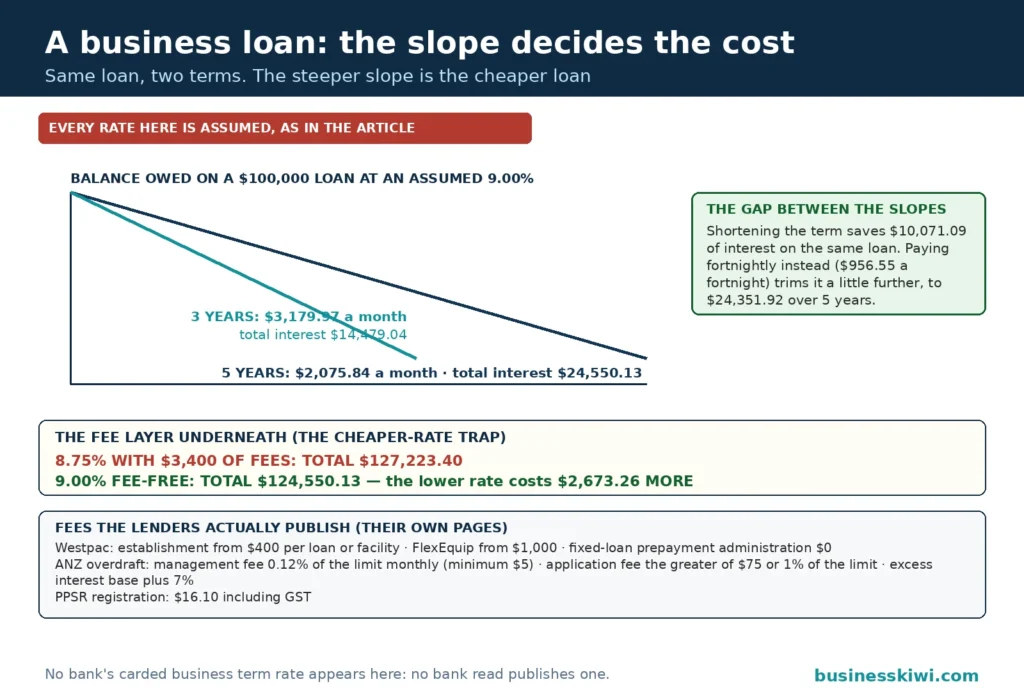
Two details in this example teach most of what owners need to know. First, the interest is front-loaded. Of the first $2,075.84 repayment, $750.00 is interest and only $1,325.84 comes off the principal. After twelve payments you have paid $24,910 in total, yet the balance has fallen only to about $83,417. Around $8,327 of the first year’s payments was interest, roughly a third of all the interest the loan will ever charge, paid in the first fifth of its life. This is why repaying early, or paying extra early, saves more than the same extra payments made later.
Second, look at the gap between the amount borrowed and the amount repaid. Borrowing $100,000 costs $124,550 over five years at this assumed rate. That $24,550 difference is the number to hold in your head when you compare offers, not the 9.00 percent.
Worked example two: the same loan over three years
Now keep everything the same and shorten the term to three years.
Shortening the term cuts total interest by about $10,071. The cost of that saving is cash flow: the monthly repayment rises by about $1,104. Business.govt.nz gives the balancing warning in its borrowing guide, asking owners to be confident they can afford repayments even during slow months and at tax time. A shorter term is cheaper on paper and riskier in a bad quarter. The right term is the shortest one your cash flow forecast can carry comfortably, not the shortest one a calculator can produce.
Repayment frequency plays a smaller part. Paying the same five-year loan fortnightly instead of monthly means 26 payments a year, the equivalent of 13 monthly payments rather than 12. At the same assumed 9.00 percent, the fortnightly repayment works out to $956.55 and total interest falls slightly, to about $24,352. Worth having, but it is fine-tuning next to the term decision.
Worked example three: when the cheaper rate costs more
Here is the comparison that catches people out. Two lenders offer the same $100,000 over five years with monthly repayments. Offer A quotes the lower rate but carries an establishment fee and a monthly account fee. Offer B quotes a slightly higher rate and charges no fees at all. Both rates are assumed for illustration.
Offer A has the lower rate, the lower repayment and the lower interest bill. It still costs about $2,673 more overall, because its $3,400 of fees outweigh the $727 of interest it saves. Judged on the headline rate, A wins. Judged on total cost, B wins by a wide margin. This is the single most useful habit this guide can give you: never compare business loans on rate alone.

The fee layer on NZ business loans
Fees are not fine print on business lending. They are a standard part of the product, and each lender publishes at least some of them.
Establishment fees are charged when the facility is set up. Westpac’s published business fees put establishment of new loans, overdrafts, guarantees and revolving accounts at from $400 per loan or facility, with its FlexEquip equipment facility starting from $1,000, and it warns a higher fee can apply if an application does not meet standard lending criteria. BNZ likewise states that establishment fees apply to its business term loans, with the detail held in the facility agreement and its business fees guide. ANZ charges an application fee on business overdrafts of the greater of $75 or 1.00 percent of the approved limit.
Ongoing facility fees tick away in the background. ANZ’s business overdraft carries a monthly management fee of 0.12 percent of the highest agreed limit available that month, with a $5 minimum. On a $50,000 limit that is $60 a month, or $720 a year, charged whether or not you use the overdraft. Westpac notes that a line of credit charge may apply to its revolving business facilities on top of interest.
Security registration fees are small but real. When a lender takes security over business assets, the security is commonly registered on the Personal Property Securities Register. The Companies Office fee schedule prices registering a financing statement at $16.10 including GST, and lenders typically pass the registration cost on to the borrower as a PPSR fee in the loan’s fee list.
Early repayment costs apply mainly to fixed rates. ANZ’s Early Repayment Recovery can apply when a fixed loan is changed or repaid early. BNZ says early repayment costs may apply if you break a loan during a fixed period, while its variable rate can be repaid at any time at no extra cost. Westpac charges no administration fee for processing a prepayment to a fixed rate loan, but notes a prepayment cost may still apply under the loan agreement itself.
Default and excess charges sit at the unpleasant end. If an ANZ overdraft goes over its approved limit, ANZ can charge excess interest at its base rate plus 7 percent per annum on the amount over the limit. BNZ applies a default rate, set out in the facility agreement, to amounts not paid on time.
The main types of business borrowing
Term loans are the product this guide’s formula prices: a set amount, a set term, regular repayments. They suit equipment, vehicles, fit-outs and other spending with a clear payoff period.
Overdrafts work differently. An overdraft is a limit attached to your transaction account, and ANZ describes the mechanics clearly: you pay interest only on the amount you use, calculated daily, with no minimum or fixed repayments. That makes an overdraft good for uneven cash flow and poor value as long-term funding, because nothing forces the balance down.
Lines of credit and revolving facilities sit between the two. BNZ’s CreditPlus and committed cash advance facilities, and Westpac’s Business Revolve account, let you draw, repay and redraw up to a limit. Interest is charged on the daily balance, and facility or line charges can apply on top, so the cost depends on your average balance rather than the limit.
Asset and equipment finance ties the loan to the thing being bought. BNZ offers asset finance for new or used vehicles, tools and equipment, and ANZ describes asset finance as borrowing against the value of an asset, work in progress or stock. The asset usually secures the loan, which can make approval easier and pricing keener than unsecured borrowing, and repayments are often shaped around the asset’s working life.
Secured, unsecured and personal guarantees
A secured loan is backed by something the lender can claim if you do not pay: business assets, equipment, or property. BNZ notes that you can secure a term loan with a residential property or other assets, and that the security you offer may affect the interest rate applied. ANZ makes the pricing point directly in its funding guide: interest rates on loans secured by property are almost always cheaper than unsecured finance, where nothing stands behind the loan.
Unsecured business loans do exist, usually for smaller amounts and stronger applicants. BNZ’s online QuickBiz channel, for example, offers term loans and overdrafts of between $5,000 and $100,000 without needing to provide additional security. Expect the rate to reflect the extra risk the lender is carrying.
Personal guarantees are where business borrowing reaches into your own finances. When a company borrows, lenders commonly ask its directors to guarantee the debt personally. A guarantee means that if the business cannot pay, the lender can pursue you for the shortfall from your own assets. It is a serious document, and it deserves independent legal advice before you sign, not a skim in the bank branch.
What the lender looks at when it prices your loan
Because business rates are set per application, it helps to know what the application is judged on. Business.govt.nz lists what to bring when you approach a bank: your financial records, including your profit and loss statements, a cash flow forecast, and a business plan. The bank’s core question, it says, is proof that you can pay back the loan and the interest.
Digital applications pull the same evidence automatically. ANZ’s goBiz service is aimed at businesses that have traded for more than two years and use MYOB or Xero, and it draws the business’s financial details straight from the accounting software into the application. BNZ says its tailored rates depend on the term, the amount and its lending criteria, and the security discussion above shows another lever: better security generally means a better rate. Business.govt.nz also cautions that borrowing options are much more limited for new businesses without financial data behind them. Trading history, tidy accounts and a credible forecast are not paperwork for its own sake. They are inputs into the price you pay.
Business borrowing and the law: fewer automatic protections
Owners who have borrowed personally often assume the same legal safety net covers a business loan. It does not. Consumer Protection, the government’s consumer guidance service, states it plainly in its credit contract definitions: any credit contract for business use is not a consumer credit contract, and different rules and rights apply.
The practical effect matters more than the legal label. The Credit Contracts and Consumer Finance Act machinery built for personal borrowers, such as standardised disclosure, hardship provisions and the short cancellation window after signing, is designed around consumer contracts. A business borrower cannot lean on those protections in the same way, so the written agreement and its fee schedule carry more weight. Read them the way you would read any contract that can reach your house, because with a personal guarantee it can.
Two things still stand behind you. Lenders remain answerable for misleading conduct in financial services, and since 1 July 2026 the Financial Markets Authority has been the regulator responsible for the Credit Contracts and Consumer Finance Act, taking over from the Commerce Commission. And the cheapest protection is the one applied before signing: a second pair of eyes, from your accountant or lawyer, on anything you do not fully understand.
How to compare two offers on total cost
Sorted, the government’s money guidance service, gives borrowers one question that cuts through most sales talk: what will be the total cost of this loan, including fees and interest, for the sum I am borrowing and the term I have chosen? Ask every lender that question, in those terms, and write the answers side by side.
Then work the comparison in a fixed order. First, use the same amount and the same term for every quote, or the numbers cannot be compared. Second, add every fee to the interest: establishment, account or facility fees across the whole term, PPSR and any discharge fee at the end. Third, stress-test the repayment. Sorted suggests asking what the regular payment would be if the interest rate were 1 percent higher than it is now, which shows how much room your budget has if a floating rate climbs or you refix higher later. Fourth, price the exit as well as the entry: a loan you may repay early should be compared including its early repayment costs, especially on a fixed rate.
If the debt is personal rather than for the business, the same method applies but the products differ, and BusinessKiwi’s guides to car finance and to small personal loans cover that ground. For business borrowing, total cost over the term you will actually keep the loan is the only fair scoreboard.
Questions to ask before you sign
- What is the total cost of this loan, including all fees and interest, over the term?
- Is the rate fixed, floating, or a base rate plus a margin, and what is the margin?
- What establishment, account, facility and registration fees apply, and when are they charged?
- Can I make extra repayments or repay in full early, and what would that cost on this rate type?
- What security are you taking, and is a personal guarantee required?
- What interest rate applies if I miss a payment or exceed my limit?
- What happens at the end of a fixed period or an interest-only period?
- What will the repayment be if the rate rises by 1 percent?
Frequently asked questions
How do I calculate a business loan repayment myself?
Use the amortisation formula or a spreadsheet. Divide the annual rate by 12 for the monthly rate, multiply the term in years by 12 for the number of payments, then use the PMT function: =PMT(rate / 12, years x 12, -amount). Total interest is the repayment times the number of payments, minus the amount borrowed.
Why do banks not publish business loan interest rates?
Because most business pricing is set per application. BNZ states that its business rates are tailored to the business and depend on factors such as the term and the amount sought, and ANZ prices facilities as a base rate plus a margin. Your trading history, financials and security all feed into the final rate.
Is a shorter loan term always better?
It is always cheaper in total interest, as the three-year example above shows, but the repayments are higher. Business.govt.nz advises owners to be confident they can meet repayments even in slow months and at tax time. The best term is the shortest one your cash flow can carry safely.
What fees should I expect on a business loan?
Common ones are an establishment fee (Westpac publishes from $400 for business borrowing), ongoing account or facility fees (ANZ charges 0.12 percent of the limit monthly on its business overdraft), a small PPSR registration cost on secured lending ($16.10 including GST on the Companies Office schedule), and early repayment costs if you break a fixed rate.
Can I repay a business loan early?
Usually yes, but the cost depends on the rate type. ANZ allows its floating business loan to be repaid in full at any time without charge, and BNZ says the same of its variable rate. On a fixed rate, early repayment costs or ANZ’s Early Repayment Recovery may apply, so ask before you sign.
What is the difference between a term loan and an overdraft?
A term loan repays a set amount over a set term with regular payments that reduce the balance. An overdraft is a limit on your transaction account: ANZ describes interest charged only on the amount used, calculated daily, with no fixed repayments. Overdrafts suit short-term cash flow gaps, not long-term funding.
Does the Credit Contracts and Consumer Finance Act protect my business loan?
Not in the way it protects personal borrowing. Consumer Protection states that any credit contract for business use is not a consumer credit contract, and different rules apply. Since 1 July 2026 the Financial Markets Authority has regulated the Act. Because the consumer protections are limited, the loan contract itself matters more, so read it carefully and take advice.
This article is general information about how business loan costs are calculated in New Zealand. It is not financial, legal or tax advice for your situation. Interest rates, fees and lending criteria change and vary between lenders, and every figure in the worked examples is an assumed amount used to demonstrate the calculation. Talk to your lender, accountant or lawyer before committing to any borrowing.
Sources
- Business loans, ANZ (anz.co.nz)
- Business overdraft, ANZ (anz.co.nz)
- How to fund your business, ANZ (anz.co.nz)
- Business First term loans, BNZ (bnz.co.nz)
- Other business service fees, Westpac NZ (westpac.co.nz)
- Borrowing money, Business.govt.nz (business.govt.nz)
- Credit contracts: Plain English definitions, Consumer Protection (consumerprotection.govt.nz)
- Transfer of responsibility for regulation of consumer credit, Commerce Commission (comcom.govt.nz)
- Questions to ask a lender, Sorted (sorted.org.nz)
- Schedule of fees, Personal Property Securities Register, Companies Office (ppsr.companiesoffice.govt.nz)