PKE Price NZ: What It Costs, What Drives It and How to Buy Well

The short answer
Palm kernel expeller, known as PKE, cost $330 to $345 a tonne in New Zealand in December 2025, according to DairyNZ. That is well below its peak of $500 a tonne. There is no single fixed retail price for PKE in New Zealand. It is a bulk imported commodity, sold on contract and quote through rural merchants and feed suppliers, so the price you pay depends on your order size, your location and the market at the time.
This guide explains what PKE is, what it costs, what drives the price, how to judge whether it is good value, and how to buy it well.
What PKE is
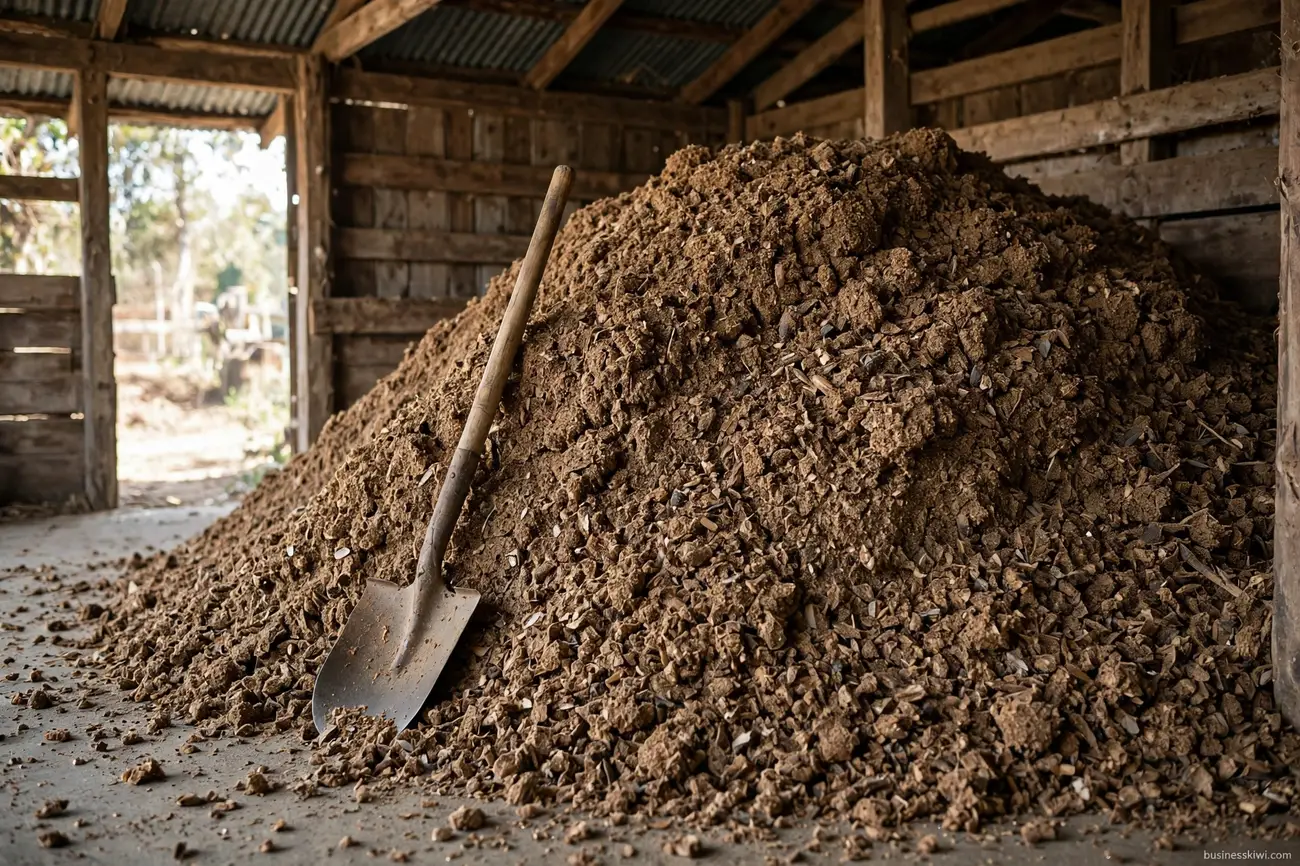
PKE is a by-product of palm oil production. After oil is pressed from the kernel of the oil palm fruit, the solid material left behind is dried and sold as stock feed. It is sometimes called palm kernel extract, which is the name DairyNZ uses, and sometimes palm kernel cake or palm kernel meal. It is the same product under all those names.
New Zealand does not grow oil palms, so all PKE is imported from South East Asia, chiefly Indonesia and Malaysia. It is the most widely used imported supplementary feed in New Zealand dairying. The country imports around 2 million tonnes of it a year, which makes New Zealand one of the largest PKE importers in the world. Almost all of it goes to dairy cows, mostly when pasture is short in summer, autumn and winter.
PKE is a dry, crumbly feed. It is about 90 percent dry matter, which means a tonne of PKE as delivered contains about 900 kilograms of dry matter. It has moderate energy and useful protein, but it is high in fibre and low in starch. DairyNZ lists its energy at 11 megajoules of metabolisable energy per kilogram of dry matter, its crude protein at 14 percent of dry matter, and its fibre (NDF) at 70 percent. A supplier specification sheet from BHL Feeds puts the energy slightly higher, at 11.7 megajoules, with crude protein of 15.5 to 17 percent and fat of 8 to 10 percent. Those figures vary from batch to batch because PKE is a by-product, so the numbers in this guide are typical values, not guarantees for any one load.
What PKE costs in NZ right now
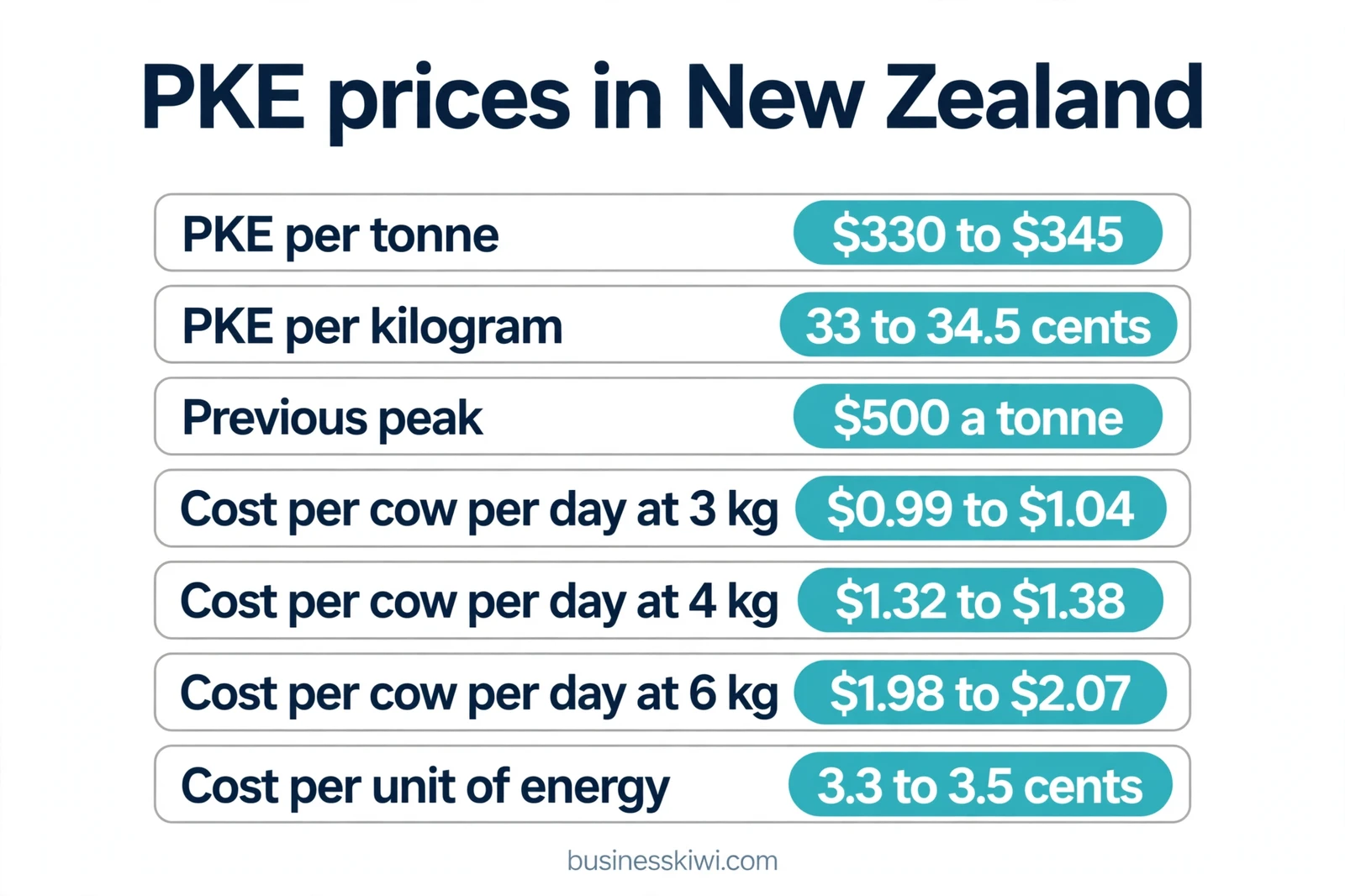
The best published New Zealand price for PKE comes from DairyNZ. Its Econ Tracker quarterly update of 10 December 2025 reported PKE at $330 to $345 a tonne, and noted that it was “still well below its peak of $500/t”. That update also reported that other feed costs were rising: maize was up $102 a tonne on a year earlier and feed wheat was up $60 a tonne. PKE was the outlier, holding its price while other feeds rose.
That December 2025 figure is the latest verified price available from an official New Zealand source. Prices move with the market, so treat it as a guide to the level, not as a price you can buy at today. Always get a current quote before ordering.
| What | Figure | Basis |
|---|---|---|
| PKE per tonne | $330 to $345 | DairyNZ Econ Tracker, 10 December 2025 |
| PKE per kilogram | 33 to 34.5 cents | Worked out from the price above |
| Previous peak | $500 a tonne | DairyNZ, December 2025 |
| Cost per cow per day at 3 kg | $0.99 to $1.04 | Worked out from the price above |
| Cost per cow per day at 4 kg | $1.32 to $1.38 | Worked out from the price above |
| Cost per cow per day at 6 kg | $1.98 to $2.07 | Worked out from the price above |
| Cost per unit of energy | 3.3 to 3.5 cents per MJ ME | Worked out from the price above and DairyNZ feed values |
A few things to note about the price. First, DairyNZ does not state whether the $330 to $345 a tonne is GST inclusive or exclusive, and it does not say whether it is a delivered price or an ex-store price. Confirm both points with your supplier before you compare quotes. Second, the price is a national-level figure. What you pay in your region will differ with freight, because PKE arrives by ship at northern ports and is trucked from there. Third, the peak of $500 a tonne shows how far the price can move. At $330 to $345, PKE was roughly a third below that peak, which is part of why farmers were using it heavily in the 2025/26 season.
Why there is no single published PKE price
If you search for a PKE price list on a New Zealand supplier website, you will not find one. Farmlands, PGG Wrightson and the other rural merchants do not publish a per-tonne PKE price online, and neither do the specialist feed suppliers. That is normal for this product, and it is worth understanding why.
PKE is a bulk commodity, not a bagged retail product. It is bought in shiploads, stored in bulk sheds and port silos, and sold in truckloads. The price a farmer pays is set by negotiation, and it depends on the size of the order, the delivery distance, the time of year and the state of the world market. A 30-tonne truckload delivered to a Waikato farm in February will cost a different amount per tonne than a 10-tonne load delivered to Southland in July.
The price also moves often. PKE is priced off the world palm oil market, the New Zealand dollar and the cost of shipping. When the dollar falls against the US dollar, imported PKE gets dearer in New Zealand dollars. When shipping rates rise, the landed price rises. When palm oil production is strong in Indonesia and Malaysia, more PKE is available and the price softens. No supplier wants to publish a price that is out of date within a week, so they quote instead.
That means the right question is not “what is the price of PKE” but “what is my delivered price, for this order, this week”. Get the quote in writing, check what is included, and compare it on the same basis as any other quote. The rest of this guide explains how.
What drives the PKE price
Five things set the price a New Zealand farmer pays for PKE.
Freight and shipping. PKE travels a long way by sea, then by truck from the port to the farm. Shipping rates and diesel prices feed straight into the delivered price, and farms further from the port pay more. This is one reason PKE is cheapest in the upper North Island, close to the ports, and dearer further south.
The New Zealand dollar. PKE is traded internationally in US dollars. When the New Zealand dollar is weak, every tonne costs more in New Zealand dollars. DairyNZ noted in its December 2025 update that a weaker dollar was lifting import prices across the board.
The world palm oil market. PKE is a by-product, so its supply depends on how much palm oil is being produced in Indonesia and Malaysia. A strong palm oil harvest means more kernels crushed and more PKE available. Weather in South East Asia, export rules in the producing countries and demand from other buyers all play a part.
Seasonal demand in New Zealand. Demand for PKE rises when pasture is short, usually in late summer, autumn and winter, and in dry years. In a drought, every dairy farmer wants supplement at the same time, and the price firms. In a good grass-growing season, demand eases.
Competing feeds. Farmers compare PKE with maize silage, pasture silage, grain and other supplements. When maize and feed wheat prices rise, as they did through 2025, PKE looks better value by comparison and demand for it rises. When grain is cheap, PKE has to compete harder on price.
Is PKE good value?
The honest way to judge a feed is not by its price per tonne but by its cost per unit of energy, because energy is what the cow turns into milk. DairyNZ puts it plainly: the cost of energy, in cents per megajoule of metabolisable energy, is the number that matters, along with storage, wastage and feeding logistics.
Worked out from the December 2025 price of $330 to $345 a tonne, and DairyNZ’s feed values of 90 percent dry matter and 11 megajoules of energy per kilogram of dry matter, PKE costs about 3.3 to 3.5 cents per megajoule of energy. That is before wastage. DairyNZ reports wastage of 10 to 20 percent when PKE is fed in bins, and 30 percent or more when it is fed out in the paddock. If 15 percent is wasted, the real cost rises to around 4 cents per megajoule. That is still cheap energy by New Zealand standards, which is why PKE is so widely used.
The table below compares PKE with other common supplements using DairyNZ’s feed values. The figures are for the feed itself, not for what it costs, because no current published prices exist for most of these feeds either. Use the table to see what each feed offers nutritionally, then price each one per unit of energy before you choose.
| Feed | Energy (MJ ME/kg DM) | Crude protein (% DM) | Nitrogen (% DM) |
|---|---|---|---|
| Palm kernel expeller | 11.0 | 14 | 2.2 |
| Maize grain | 13.6 | 8 | 1.3 |
| Barley | 13.0 | 11 | 1.8 |
| Pasture silage, good | 10.0 | 17 | 2.7 |
| Maize silage | 10.3 | 8 | 1.3 |
| Molasses | 12.0 | 4 | 0.6 |
| Dried distillers grains | 12 to 13 | 25 to 33 | 4.0 to 5.3 |
PKE has some real limits as a feed. Its energy is lower than grain, so it is not the best choice when cows need a lot of energy in a small amount of feed. It is very high in fibre but has almost no effective fibre, which means it must be fed with long forage such as pasture or silage so the rumen works properly. It is also high in nitrogen at 2.2 percent of dry matter, which adds nitrogen to the farm system and to urine patches. And its fat content, at around 8 percent, is what causes the milk fat issue described below. None of that makes PKE a bad feed. It makes it a feed that suits a particular job: cheap, bulky energy to fill a pasture gap, fed in moderate amounts alongside good forage.
How to buy PKE
PKE is sold through rural merchants, feed suppliers and Fonterra’s Farm Source stores. The main sellers are the companies that import it in bulk and distribute it: rural supply co-operatives, specialist feed merchants such as Agrifeeds and BHL Feeds, and grain and feed companies. Most farmers buy through their usual rural merchant or their feed rep, who arranges delivery by truck.
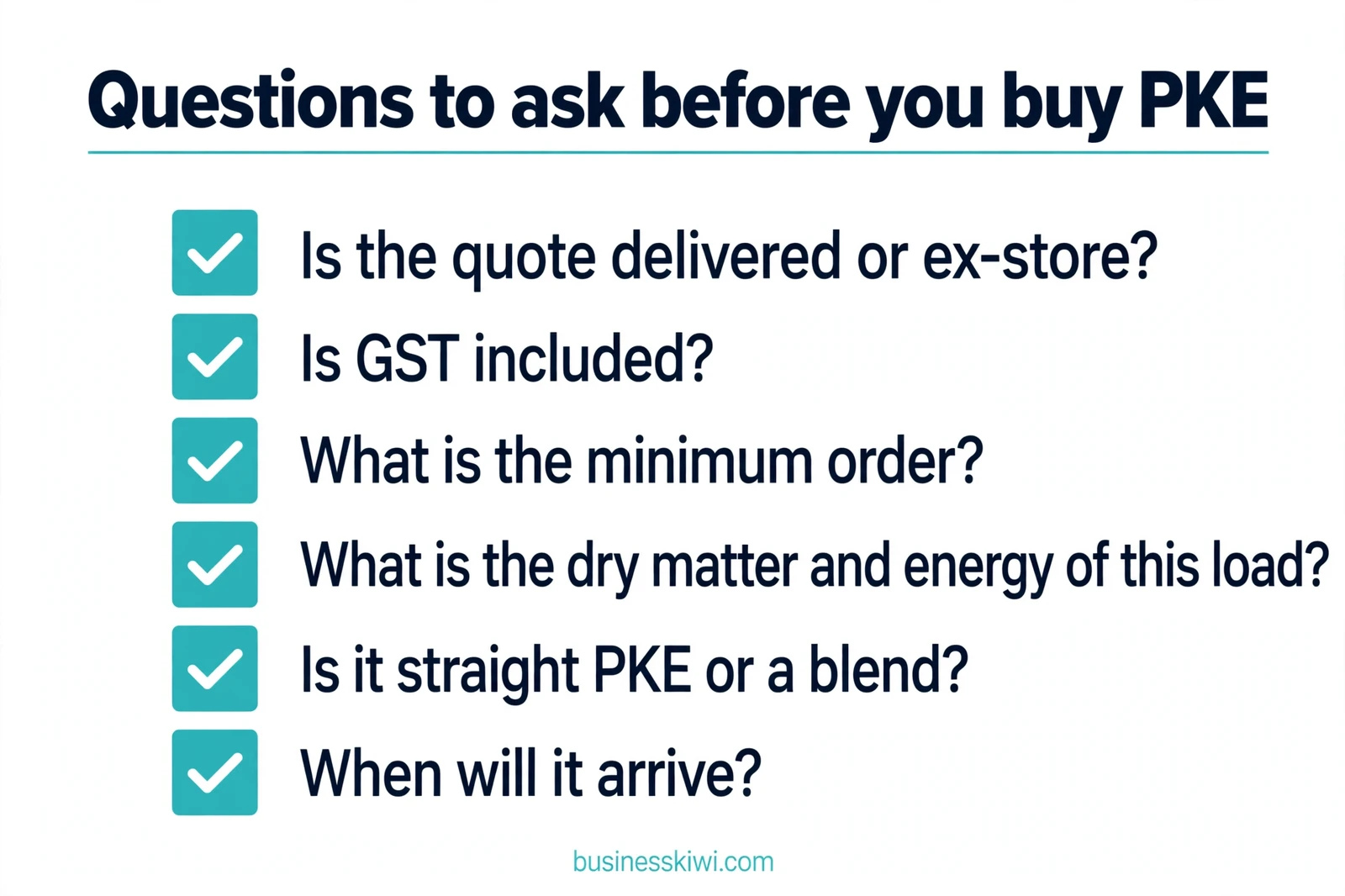
Before you order, ask these questions.
Is the quote delivered or ex-store? A price that looks cheap can turn expensive once delivery is added. Ask for the delivered price to your farm, and ask what the delivery charge is separately so you can compare.
Is GST included? Confirm whether the quote is GST inclusive or exclusive. A quote that leaves GST out will look 15 percent cheaper than one that includes it.
What is the minimum order? Bulk PKE is usually sold by the truckload. Smaller orders may cost more per tonne, or may not be available at all. If you only need a small amount, ask about bags or a shared load with a neighbour.
What is the dry matter and energy of this load? PKE varies from batch to batch. Ask the supplier for the analysis of the load you are buying, and check the dry matter. A load at 85 percent dry matter gives you less feed per tonne than a load at 90 percent.
Is it straight PKE or a blend? Some suppliers sell PKE blended with tapioca or other ingredients. DairyNZ lists an in-shed mix of 25 percent tapioca and 75 percent PKE at only 8.45 megajoules of energy, well below straight PKE at 11. A blend can be good value, but only if you know what is in it and what it costs per unit of energy.
When will it arrive? In a dry autumn, demand spikes and delivery can take days or weeks. Order before you run out, and keep a buffer on hand if you can store it.
Get the quote in writing, keep a note of the date, and compare quotes on the same basis: delivered, GST inclusive, per tonne, for the same product. If one quote is much cheaper than the rest, ask why before you buy.
How much to feed and how to feed it
PKE is a supplement, not a complete diet. It fills the gap when pasture is short. How much you feed depends on the pasture available, the stage of lactation and what else the cows are eating, so the figures below are starting points from the suppliers and DairyNZ, not a ration for your herd. Talk to your vet or a nutritionist before you change feeding rates.
Introduce PKE slowly. BHL Feeds advises starting adult dairy cows at 500 grams per cow per day and building up to a maximum of 6 kilograms per cow per day, with normal feeding rates of 2 to 4 kilograms a day. DairyNZ advises that PKE should not be more than 30 percent of the cow’s diet, partly because cows may not like the taste and partly because of the fat and mineral load. A Massey University study found that cows offered 6 kilograms a day actually ate only 3.6 kilograms, which shows that palatability can limit intake at high rates.
Feed PKE with long forage. Because PKE has almost no effective fibre despite its high fibre content, it must be fed alongside pasture, pasture silage or maize silage. Feeding PKE on its own, or with only short-chop feeds, risks upsetting the rumen.
Watch the minerals. PKE is high in phosphorus, so DairyNZ advises against feeding high levels close to calving, when the risk of milk fever is highest. It also advises watching copper levels if cows eat a lot of PKE, and notes that PKE is high in potassium and other minerals that vary from batch to batch. Having your feed tested by a reputable laboratory is the way to know what you are actually feeding.
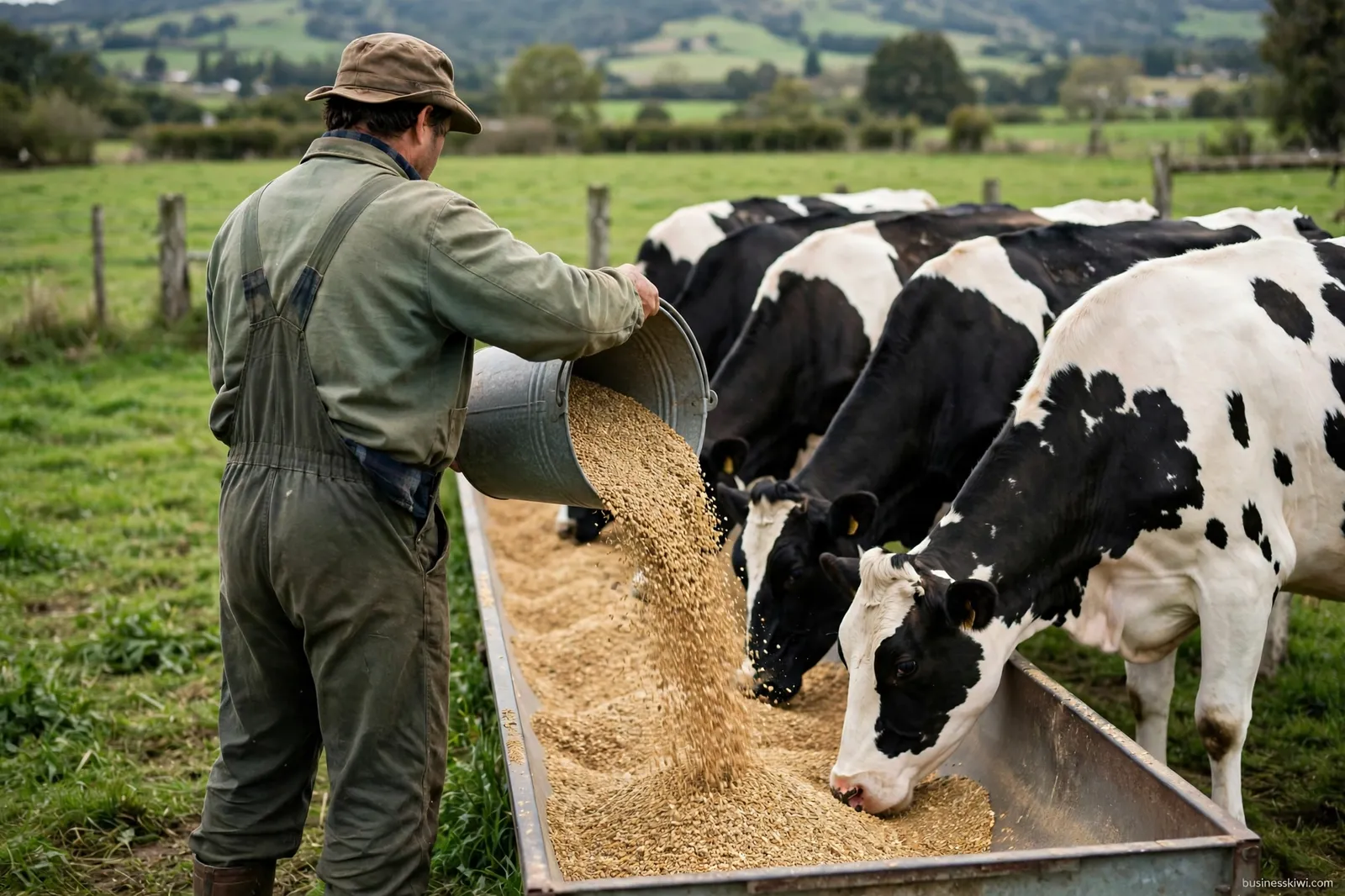
Feed it in bins where you can. Wastage is 10 to 20 percent in bins and 30 percent or more in the paddock, according to DairyNZ. A hay feeder, a feed bin or an in-shed system keeps more of what you paid for in the cow. If you feed in the paddock, expect to lose a third of it to trampling and weather.
Storage and handling
PKE stores well if it is kept dry. It is 90 percent dry matter, so it does not go off quickly, but it will take up moisture and go mouldy if it gets wet. Store it under cover, on a dry floor, and keep it away from birds and rodents, which will eat it and foul it. BHL Feeds and Agrifeeds both give the same advice: store in a dry area and take precautions against bird and rodent infestation.
If you are storing PKE for months, check it regularly for mould and for heating. A load that heats up is a sign of moisture and microbial activity, and it should not be fed. Keep the oldest stock at the front and use it first. If you use a silo or a bulk shed, make sure it is clean and dry before the load arrives, and keep the delivery docket with the load details so you know what you bought.
Handling PKE is dusty work. Wear a dust mask when you are working around it in an enclosed space, and follow the same care you would with any bulk feed. If you are setting up or changing feed storage, our dairy farm health and safety guide covers the basics of working safely around farm infrastructure.
PKE and milk fat: the FEI limit
The most important thing to know about feeding PKE is its effect on milk fat. PKE contains short and medium chain saturated fatty acids that are not generally found in other dairy feeds. When cows eat a lot of PKE, those fatty acids change the composition of the milk fat, which can make the milk harder to manufacture into products such as butter and can put it outside customer specifications.
Fonterra measures this with the Fat Evaluation Index, or FEI, which appears on milk dockets. DairyNZ explains that Fonterra has placed a limit on the amount of PKE that can be fed to keep some of these fatty acids below a threshold. The practical guidance DairyNZ gives is to monitor your FEI graph, and if you start to approach the B band, check how much PKE you are feeding, weigh the feed when loading, and consider an alternative feed or a PKE blend.
DairyNZ’s own worked example is a cow eating 3 kilograms of PKE. The same 3 kilograms has a bigger effect on FEI when the cow’s total diet is 15 kilograms than when it is 18 kilograms, because PKE is a larger share of the diet. That is why the proportion matters more than the absolute amount. In winter and spring, DairyNZ suggests feeding PKE to dry stock and giving the pasture and silage to the milking cows. In summer and autumn, it suggests drying off stock and feeding PKE to dry cows, or removing cull cows earlier, so the milking herd gets more pasture or alternative supplements.
If you supply Fonterra, keep an eye on your FEI and talk to your Farm Source team if it climbs. If you supply another company, ask what its requirements are, because they may differ. The cost of a milk fat penalty can quickly wipe out the saving from cheap feed.
Alternatives to PKE
PKE is not the only way to fill a pasture gap, and sometimes it is not the best one. The right alternative depends on what is available, what it costs per unit of energy, and what your cows need.
Maize silage is the most common alternative in the North Island. It has similar energy to PKE at 10.3 megajoules, but much lower protein and nitrogen, and it provides effective fibre. Pasture silage, fed out as baleage through a round bale feeder, is similar in energy and higher in protein, but its quality varies a lot. Maize grain and barley have higher energy, at 13.6 and 13.0 megajoules, but lower protein and higher starch, so they need careful introduction. Molasses is high in energy at 12 megajoules and is often fed with PKE to improve palatability and lift energy. Dried distillers grains are high in both energy and protein, but also high in nitrogen. Kiwifruit, onions and other by-products are used in some regions, but they carry their own risks and need careful management.
When you compare, price each option per unit of energy, allow for wastage, and allow for the extra costs of feeding it out. A feed that looks dear per tonne can be cheap per unit of energy if it has high energy and low wastage, and the reverse is also true. DairyNZ’s supplement price calculator is designed for exactly this comparison.
If you are working out how much supplement your farm needs, it helps to know how many cows your land can carry. Our stocking rate calculator can help you work through the numbers, and our farm finance guide explains how to think about feed costs in the context of the whole farm budget.
The sustainability question
PKE comes from the palm oil industry in South East Asia, and palm oil production has been linked to the clearance of tropical rainforest. That link has made PKE controversial in New Zealand, and it is a genuine consideration for farmers who care about where their inputs come from.
There is no simple answer. PKE is a by-product that would otherwise be waste, and it is a cheap feed that keeps New Zealand dairy farms running through dry periods. On the other hand, buying it supports an industry that has cleared forest in Indonesia and Malaysia. Some suppliers now offer PKE from certified sustainable sources, and some buyers ask for it specifically. If this matters to you, ask your supplier where their PKE comes from and whether certified sustainable product is available, and weigh the price difference against what it is worth to you. The rest of this guide is about price and feeding, and that is where the decision is usually made.
For more on farm and rural business, browse the Business and Industry section.
Frequently asked questions
How much does PKE cost per tonne in NZ?
DairyNZ reported PKE at $330 to $345 a tonne in its Econ Tracker update of 10 December 2025, well below its peak of $500 a tonne. There is no fixed published retail price, so the price you pay will depend on your order size, location and the market at the time. Get a current delivered quote, GST inclusive, before you order.
Why is PKE so cheap compared with other feeds?
PKE is a by-product of palm oil production, imported in bulk from South East Asia, so it has low processing costs and arrives in large volumes. It is cheap per tonne and cheap per unit of energy, at about 3.3 to 3.5 cents per megajoule before wastage. It is also lower in energy than grain and has high wastage when fed in the paddock, so the price advantage narrows once those are allowed for.
How much PKE can I feed a cow?
Introduce it slowly at 500 grams per cow per day and build up to a maximum of 6 kilograms, with normal rates of 2 to 4 kilograms a day, according to BHL Feeds. DairyNZ advises that PKE should not be more than 30 percent of the cow’s diet, and it must be fed with long forage such as pasture or silage. Always talk to your vet or a nutritionist before changing feeding rates.
Does PKE affect milk fat?
Yes. PKE contains fatty acids that change the composition of milk fat, which can make milk harder to manufacture. Fonterra measures this with the Fat Evaluation Index, or FEI, shown on milk dockets. If your FEI climbs towards the B band, DairyNZ advises checking how much PKE you are feeding, weighing the feed, and considering an alternative feed or a PKE blend.
Is PKE safe to feed?
PKE is a safe supplement for most classes of livestock when it is introduced slowly and fed as part of a balanced diet. DairyNZ notes that the risk of foot and mouth disease coming in on PKE is low, because of the heat processes used to make it and the strong import health standards in place. Watch phosphorus levels close to calving, watch copper if cows eat a lot of it, and have your feed tested if you are unsure.
Where can I buy PKE in NZ?
Through rural merchants such as Farmlands and PGG Wrightson, through Fonterra’s Farm Source stores, and through specialist feed suppliers such as Agrifeeds and BHL Feeds. It is sold on contract and quote, usually by the truckload, so ask for a delivered price and get it in writing. No New Zealand supplier publishes a fixed per-tonne price online.
What can I feed instead of PKE?
Maize silage, pasture silage, maize grain, barley, molasses and dried distillers grains are the main alternatives. Each has different energy, protein and nitrogen levels, so compare them on cost per unit of energy, allow for wastage, and consider what your cows need. DairyNZ’s supplement price calculator is a useful tool for the comparison.
This guide is general information only. Prices, feeding rates and product details were checked against the sources named in the article at the time of writing, in November 2026. Prices move with the market, so get a current quote before you buy. Feeding rates are starting points, not a ration for your herd, so talk to your vet or a nutritionist before you change what your cows eat.